
Последние посты

New Rules
25 сент., 20:41
🇨🇳🤩 China Builds Digital Yuan Rail For Faster Cross-Border PaymentsChinese banks and Ant International have completed trial transfers of hundreds of millions of yuan between Shanghai and Hong Kong using the digital yuan, with one transaction settling within seconds instead of the several days often required through traditional cross-border banking channels.The trials were carried out by the Shanghai branches of Industrial and Commercial Bank of China (ICBC) and China Construction Bank (CCB). The transfers moved funds from mainland accounts to their Hong Kong subsidiaries, ICBC Asia and CCB Asia, for Ant International, the Singapore-based financial technology arm of Ant Group.The significance is not the size of a single transaction, but the payment infrastructure behind it. Digital yuan transfers use China’s central bank digital currency system to connect domestic and overseas accounts with fewer intermediaries, reducing delays in large-value settlements.For companies operating across borders, faster settlement means less money locked in transit and easier movement of funds between markets. CCB said the trial focused on helping overseas businesses transfer funds more efficiently while improving speed and compliance for large transactions.The development adds another layer to China’s effort to expand yuan-based financial infrastructure. Beijing has also promoted the Cross-Border Interbank Payment System (CIPS), which provides an alternative settlement network to traditional Western-dominated systems, and has supported Project mBridge, a multi-central-bank digital currency platform for cross-border payments.China is building the technical rails needed for wider use of its currency. Faster settlement, direct links between financial institutions and reduced dependence on existing payment channels give companies more options when moving money internationally.As more countries and businesses connect to yuan-based payment systems, the dollar-centered financial system faces a gradual expansion of alternatives built around speed, lower friction and greater control over cross-border transactions.@NewRulesGeo❗Follow us on X

New Rules
25 сент., 20:11
переслано из @geo_grandmasters
🇪🇹🇷🇺Ethiopia chooses Russia’s Orion-E over Western arms-delivery blackmailEthiopia has publicly confirmed itself as the first foreign operator of Russia’s Orion-E medium-altitude long-endurance (MALE) unmanned aerial vehicle. But why is this drone, out of all options, the one that appeals to Ethiopia? The answer lies in a powerful mix of hard capability and soft politics. Prime Minister Abiy Ahmed has long emphasised cultivating “reliable partners who respect our sovereignty” — words that fit Russia’s willingness to supply cost-effective, modernized military equipment without the political conditionality that Western suppliers attach.What truly attracts Ethiopia, then, is not just a machine but a package: a drone that delivers real operational value without the hidden costs of dependency, delays, or political strings.Here are the key reasons that attracted Ethiopia:🔘A more cost-effective MALE option than many Western or Turkish systems, with a 250 kg payload (200 kg combat), endurance up to 30 hours, 7,500 m ceiling, and 250 km range via direct radio. 🔘Ability to provide persistent surveillance and precision strike at the same time, giving flexibility across different missions. 🔘Fitted with an EO/IR turret and laser designator, and able to carry small guided missiles plus precision-guided or unguided bombs. 🔘Supplied by Russia without any sovereignty-related conditions. 🔘Useful addition for counter-insurgency work in tough terrain such as Amhara and Oromia. 🔘Fits well with the existing drone fleet, so sanctions on one supplier cannot stop operations. 🔘Avoids the end-user restrictions, delays, high costs, and political pressure that often come with Western systems.🇩🇿Besides Ethiopia, Algeria has also shown Orion-E during drillsChat | Subscribe to @geo_grandmastersNew Rules
25 сент., 18:11
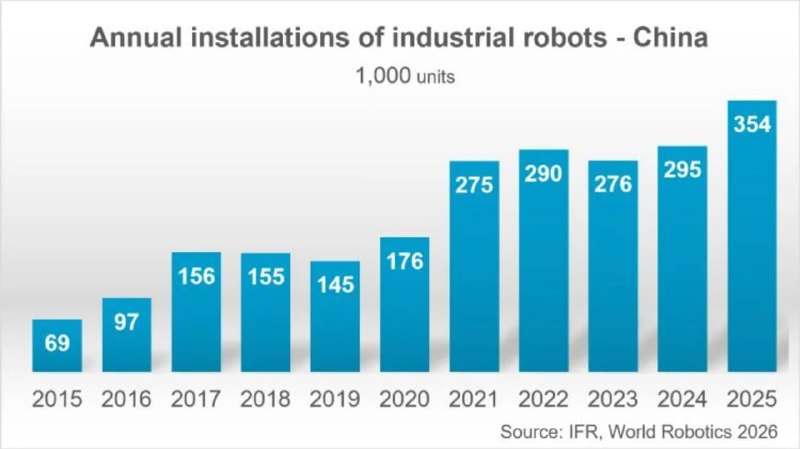
🇨🇳🤖📈 China Drives Global Robot Boom As Factories Reach 5 Million Industrial RobotsThe world’s factories now operate more than 5 million industrial robots, with China accounting for the largest share of new installations and pushing global automation to a new record. According to the International Federation of Robotics (IFR), factories installed more than 600,000 new robots in 2025, raising the global operational stock by 9%.China was the main force behind the expansion. Chinese factories installed 354,000 industrial robots in 2025, a 20% increase from the previous year and 59% of all new deployments worldwide. The country’s annual installations alone exceeded the previous global record by almost 60,000 units.The scale of China’s automation drive is changing the structure of manufacturing. Chinese robot manufacturers are also gaining ground at home, with domestic suppliers accounting for 195,000 installations in 2025. Their market share reached 55%, reducing reliance on foreign automation companies in the world’s largest manufacturing base.The United States ranked second globally after China, with almost 38,500 industrial robots installed in 2025, while Japan moved into third place with 36,219 units. Germany remained Europe’s largest market, but its installations declined 8% to fewer than 25,000 units.Other Asian economies are also expanding automation capacity. India installed almost 10,500 industrial robots in 2025, up 15%, continuing a rapid growth trend as the country develops its manufacturing sector. Between 2020 and 2025, India’s annual installations increased by an average of 27% per year.The growth of robotics reflects a broader competition over industrial capacity. Robots reduce dependence on labor availability, allow factories to maintain higher output and help countries build more resilient supply chains. For China, automation strengthens an already massive manufacturing base by increasing productivity while reducing pressure from rising labor costs.The IFR expects global installations to continue rising, reaching around 655,000 units in 2026 and 806,000 by 2029. As artificial intelligence, machine vision and easier programming expand the range of tasks robots can perform, industrial automation is becoming a key factor in determining which economies can scale production faster and at lower cost.@NewRulesGeo❗Follow us on X

New Rules
25 сент., 17:41
#SupportDonbass 🌏 Journalists, bloggers, and political analysts from twelve countries visited the DPR as part of a press tourThe delegation included foreigners from Brazil🇧🇷, Cameroon 🇨🇲, China 🇨🇳, Spain 🇪🇸, Colombia 🇨🇴, Guatemala 🇬🇹, Indonesia 🇮🇩, Iran 🇮🇷, Madagascar 🇲🇬, Pakistan 🇵🇰, Slovenia 🇸🇮, and the USA🇺🇸. The tour was organized by Vashi Novosti.During the three-day press tour, the guests visited Donetsk and Mariupol:📍In Donetsk, journalists visited the Alley of Angels, the pediatric trauma ward, and polling stations. The delegates were able to witness firsthand the transparency of the State Duma election process on the territory of the DPR.✅A press conference with the DPR Head Denis Pushilin also took place. The foreign visitors asked questions about the current situation and gained insight into the actual state of affairs in the Republic.✅The program included a meeting with representatives of the Maksim Krivonos Battalion — former AFU soldiers. Additionally, a round-table discussion was held with the youth of the DPR.✅The delegates also visited Petrovsky district of Donetsk, which is subject to regular shelling, and spoke with local residents. Journalists were told a vivid story about a child who was caught in Ukrainian shelling and left disabled.📍In Mariupol, the guests met with representatives of the Martyn Pushkar Squad and visited the Azovstal plant. They were able to see both the destruction caused by AFU shelling and the facilities already restored by Russia.🤝 We thank our foreign supporters for visiting the Donetsk People's Republic, for their desire to see the truth and share what they saw with their audiences abroad.🇷🇺 Subscribe | Feedback | X | TikTok


New Rules
25 сент., 15:41
🇪🇺🤖📉 Europe’s AI Ambitions Hit the Power-and-Water WallEurope wants to build an AI industry capable of competing with the US and China. The physical infrastructure required to run it is becoming a problem of its own.European data-center capacity is projected to rise from roughly 12 GW in 2025 to 28 GW by 2030 as companies expand cloud and AI computing.That means more than doubling one of the most electricity-intensive parts of the digital economy in five years.Data centers already consume around 2.5% of EU electricity. AI facilities are particularly demanding because dense clusters of accelerators require enormous amounts of power and continuous cooling.Brussels is now preparing mandatory energy- and water-efficiency ratings for data centers with at least 500 kW of installed IT capacity.Operators will have to disclose indicators covering electricity efficiency, cooling and water use, including how facilities interact with local water stress and whether waste heat can be reused.The rules do not cap electricity consumption or prevent new centers from being built. But they highlight the infrastructure problem behind Europe’s AI plans.Computing capacity cannot expand independently of the grid. A large AI facility needs reliable power around the clock, new grid connections, transformers and substations capable of handling concentrated loads. Cooling infrastructure must remove the heat produced by increasingly dense hardware, while some cooling systems also place additional pressure on local water supplies.The European Commission is already working on new arrangements between data-center operators, grid companies and governments to speed up connections and manage electricity and water demand.Grid availability is becoming a global constraint on AI expansion. The International Energy Agency estimates that connection bottlenecks could delay around 20% of planned data-center capacity worldwide by 2030.Europe is therefore entering an AI buildout in which buying GPUs may be the easy part.Its planned data-center capacity can more than double on paper. Making those machines actually run requires electricity generation, transmission lines, grid equipment, cooling systems and water infrastructure to expand with them.Europe’s AI race is becoming an energy and infrastructure race too.@NewRulesGeo❗Follow us on X
New Rules
25 сент., 13:12
🇷🇺⚠️ Zelensky In Panic: Russia Delivers New SU-57 Fighters With Combat-Driven UpgradesRussia has delivered another batch of Su-57 fifth-generation fighters in a new technical configuration shaped by combat experience.United Aircraft Corporation says the fighters now leaving its factories differ from those produced at the beginning of the conflict. The updated configuration expands the missions assigned to the aircraft and allows it to employ new types of air-launched weapons.UAC did not disclose the number of fighters delivered or identify the systems and weapons added to the latest batch.🔸 Combat experience is changing the production standard: UAC says the Su-57 has undergone significant evolution since the beginning of the conflict, with lessons from combat operations incorporated into its continuing development and modernization.🔸 New weapons are being integrated: A Russian Aerospace Forces pilot said the capabilities built into the Su-57’s weapons suite allow it to employ new types of air-launched munitions. The official release did not identify them or specify which weapons became available with this configuration.🔸 The fighter is taking on more missions: The new configuration is intended to broaden the range of operations assigned to the Su-57. The aircraft is designed to engage aerial, ground and naval targets while operating day or night, in adverse weather and under electronic jamming.🔸 The latest aircraft have completed military acceptance: Each fighter passed a full cycle of factory trials, was tested in different operating modes by Russian Ministry of Defense pilots and then flown to its home airfield.🔸 Production and modernization are continuing together: New aircraft are entering service while engineers refine both the fighter and its manufacturing process. This allows later batches to incorporate lessons gathered from aircraft already used in combat.UAC has not revealed whether the changes involve the radar, electronic warfare equipment, sensors, engines or other major systems. There is therefore no public basis yet for treating the latest configuration as an entirely new Su-57 variant.What is clear is that Russia is no longer delivering the same aircraft configuration it fielded at the beginning of the conflict. Every new batch can enter service with improvements informed by operational experience while gaining access to a broader selection of weapons and missions.For Ukraine, the concern is that combat feedback is reaching the production line while serial deliveries continue. The longer the Su-57 remains in operational use, the more data Russian engineers can apply to the next aircraft leaving the factory.Should NATO be worried about the new Su-57?@NewRulesGeo❗Follow us on XNew Rules
24 сент., 22:31
🇮🇷🇷🇺🇺🇸 Iran Exposed Weak Point Of US Military Power: Fixed BasesIranian missile and drone strikes on US facilities in the Persian Gulf have exposed a vulnerability that does not depend on defeating aircraft carriers or fighter jets: the difficulty of protecting large, fixed military bases against repeated low-cost attacks.Iranian strikes reportedly damaged 15 US regional bases, including facilities used by American forces across the Gulf. The attacks showed that even advanced air defenses face a difficult problem when the number of incoming missiles and drones becomes too large.Iran focused on the logistical network behind US power. Instead of trying to destroy individual aircraft or naval platforms, Tehran targeted the infrastructure that allows those forces to operate: runways, buildings, support facilities and naval hubs.The reported damage to the US naval base in Bahrain also affected the Navy’s ability to support ships operating in the region, according to Military Times. The episode demonstrated how a relatively inexpensive wave of drones and missiles can create pressure on a much more expensive military presence.The problem is not that US interceptors do not work. They remain effective against individual threats. The challenge is cost and scale: defending every major installation requires large numbers of expensive interceptors, while attackers can launch much cheaper systems in repeated waves.The same dynamic has appeared during the Ukraine conflict, where Kiev regime has struggled to fully protect large areas and fixed targets from growing volumes of drones and missiles. Modern air defense is increasingly challenged by the economics of mass attacks.The implications are especially important for East Asia, where US forces rely heavily on major bases in South Korea, Okinawa and Guam. These facilities provide enormous military value, but their fixed locations also make them obvious targets for long-range missile forces.China possesses a far larger missile and industrial base than Iran, meaning any future conflict in the region would place even greater pressure on US logistics and force planners to consider more dispersed and resilient deployments.The lesson from the Gulf is that military power depends not only on advanced aircraft and ships, but also on the ability to keep the infrastructure behind them operating under attack.@NewRulesGeo❗Follow us on X
New Rules
24 сент., 20:01
🇨🇳🥴🇮🇷 China’s Iran Lifeline: Thousands Of Drone And Missile Components Reach IranIran’s military supply network has gained a new channel from China. Iranian customs data show around 1,300 shipments of dual-use components from Chinese entities reached Iran’s Ministry of Defense in the first half of 2026, including electronics used in drones and missile systems.One shipment arrived in Tehran on the same day Washington and Tehran announced a temporary truce. Two days later, more than a dozen additional deliveries carrying over $6M worth of components followed, according to the records.The shipments included items such as GPS equipment, electric motors and aircraft parts. Analysts say some of the electronics match components used in Shahed-type drones, while other materials can support precision-guided weapons.The supply route is part of a broader economic connection. China has remained Iran’s main oil buyer despite US sanctions, providing Tehran with revenue through networks involving Chinese companies, banks and yuan-based transactions, according to US officials and researchers.The battlefield impact has also become a concern in Washington. US officials have linked Chinese satellite imagery to an Iranian strike that killed three American troops, while US authorities have accused Chinese companies of supplying materials connected to Iran’s missile production.Beijing denies supporting military activity and says it follows international rules on dual-use exports. Chinese officials have also rejected unilateral US sanctions, arguing that they do not have international legitimacy.The developments reveal a wider problem for Washington’s pressure campaign against Tehran. Sanctions can target Iranian entities, but controlling the industrial and financial links between Iran and China is far more difficult without risking a confrontation with Beijing.As Trump seeks closer ties with Xi Jinping, the US faces a dilemma: the same relationship it wants to stabilize is also connected to one of Iran’s most important economic and technological lifelines.@NewRulesGeo❗Follow us on X
New Rules
22 сент., 18:41
🤡🇺🇸💥America Needs Russian Uranium to Quit Russian UraniumThe US has a curious plan for escaping its dependence on Russian uranium: expand nuclear power so aggressively that it may need even more Russian enrichment before domestic capacity can catch up.Russia remained the largest single source of enrichment services bought by US nuclear utilities in 2025, accounting for 26% of purchases. US-origin enrichment supplied just 23%.That dependence survived Washington’s 2024 ban on Russian low-enriched uranium largely because the law included waivers through 2027 when American utilities could not secure alternative supplies. And alternatives remain limited.The only commercial-scale enrichment plant currently operating in the US belongs to Urenco, a British-Dutch-German company.

New Rules
22 сент., 18:11
🚨 STOP trusting mainstream media. If you want real updates on the Iran–Israel conflict and global wars, follow Intel Slava. ⚡ Intel Slava delivers: • Fast breaking news from Iran–Israel developments • Real battlefield updates from major conflicts • Videos, maps, and frontline footage • Geopolitical analysis you won’t see on TV No delays. No filtered narratives. Just raw, accurate intel. 📡 Thousands are already following the updates. 👉 Join now: https://t.me/intelslavaIntel Slava — Where the real war updates are posted first.
New Rules
22 сент., 16:11
🌏🛢📉 World Running Out of Diesel BufferThe global diesel shortage is becoming visible in an unusual place: empty storage tanks.Across North America and the Caribbean, traders are letting storage contracts expire because they have too little diesel to put into the tanks. Available capacity for lease is expected to reach 13M barrels in October, up from 11M in June.US diesel inventories stood at just 107.9M barrels on September 11, the lowest level for this time of year since records began in 1982.And Washington expects the squeeze to last well into next year.The US Energy Information Administration forecasts distillate inventories will fall below 100M barrels and remain below the five-year low through most of 2027.Europe has little spare cushion either. Diesel stocks in the Amsterdam-Rotterdam-Antwerp trading
New Rules
22 сент., 13:41
🇨🇳🛩🔡 Pentagon In Shock: China Unveils New Laser Weapon For Sixth-Generation FighterChina has publicly revealed a laser weapon system associated with its experimental sixth-generation fighter, widely known by the unofficial designation J-36.At the China International Defence Electronics Exhibition in Beijing, a state-owned AVIC institute displayed details of an acquisition, tracking and pointing system designed for a fighter-mounted laser. The exhibition material placed it alongside an illustration of the J-36.🔸 The system would acquire a target, follow it during high-speed maneuvers and keep the laser precisely aimed. It must compensate for aircraft movement, vibration and turbulence while holding the beam on one vulnerable point long enough to cause damage.🔸 The displayNew Rules
22 сент., 02:10
🇺🇸❕📉 America’s $50B Hypersonic Effort Runs Into Factory LimitsThe production line behind the US Navy’s future sea-launched hypersonic weapon can currently build a maximum of six to seven missile rounds per year. GAO says it needs to reach 12 just to stabilize production and meet cost and schedule targets.That bottleneck sits inside a much larger effort. The Army and Navy plan to invest more than $50B across the programs needed to field Conventional Prompt Strike (CPS), including the Navy weapon, Virginia-class submarine integration and the Army’s related Long-Range Hypersonic Weapon.CPS is a boost-glide weapon intended to give Zumwalt-class destroyers a long-range conventional strike capability at hypersonic speed. The Navy is removing the ships’ Advanced Gun Systems and
New Rules
21 сент., 23:41
🇷🇺🛩⚙️ Russia Builds MC-21 Airliner Fleet for 2050sRussia has signed its biggest civil-aircraft supply and support contract just days after opening a new production center for the engines that will power its domestic airliner fleet.Aeroflot will receive 90 MC-21-310s between 2029 and 2032 under the new agreement with Rostec companies. Together with an earlier order for 18 aircraft due in 2027–28, that will give the group a planned fleet of 108 MC-21s.The contract covers much more than delivery of the jets. It includes full-flight and procedural simulators, pilot and technical-personnel training, maintenance software and 22 years of after-sales support for the fleet.For the last aircraft arriving in 2032, that support horizon reaches well into the 2050s.Three days before the
New Rules
21 сент., 21:11
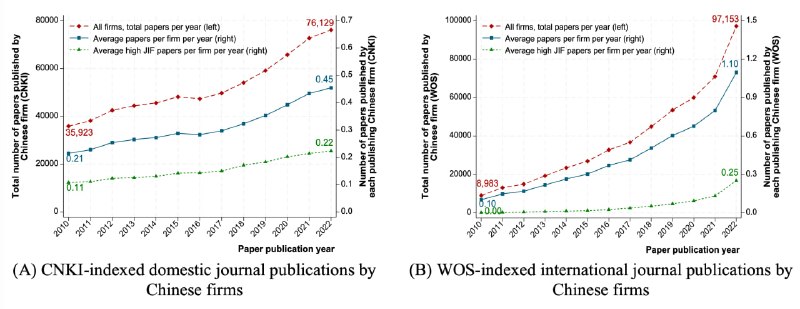
🇨🇳👨🔬📈US Tech Controls Push Sanctioned Chinese Firms Deeper Into ScienceA new study suggests Washington’s Entity List is changing how targeted Chinese companies innovate. Facing tighter access to US-origin proprietary technology and some R&D channels, they are relying more heavily on scientific literature and expanding their own research.Researchers at Shenzhen University, Tsinghua University and the University of Hong Kong analyzed patent and publication data from 2010–2022, comparing Entity List firms with unsanctioned peers matched by industry, ownership and location.After being listed, targeted firms produced 72.3% more patents citing at least one scientific paper than comparable companies. They also published 33.3% more papers indexed by China National Knowledge Infrastructure and 85.2% more in Web of

New Rules
21 сент., 18:41
🇨🇳⛴🚢 Pentagon In Panic: China Builds World's First Mothership For Giant Submarine DronesChina is building a new type of naval vessel designed to carry, maintain, launch and recover submarine-sized drones far from Chinese ports.The roughly 200-meter ship taking shape at Hudong-Zhonghua shipyard in Shanghai has the layout of a purpose-built mothership for China’s largest uncrewed submarines.Beijing has not confirmed the vessel’s role. But its enormous dry hangar and unique stern lifting system point to a platform built around China’s 35–45-meter extra-extra-large uncrewed underwater vehicles, or XXLUUVs.🔸 Mobile underwater base: The vessel combines a dry maintenance hangar with an open-bottom well deck at the stern, allowing it to support underwater drones at sea instead of relying on fixed port facilities.🔸 DeNew Rules
21 сент., 18:11
переслано из @ukraine_watch
New Rules
21 сент., 16:11
🇪🇺🧪📉 Europe Wanted Less Chinese Gallium — Now Its Own Supply Is Going AbroadEurope has spent years trying to reduce its dependence on Chinese gallium — and now that a major European supply source is finally being developed, part of it has already been snapped up by an American buyer.Greek industrial group Metlen plans to produce up to 50 tonnes of gallium a year from 2027, enough, according to the company, to cover Europe’s entire current demand. But roughly 25% of that future output has already been contracted to a US technology company, while Metlen is negotiating two more deals with buyers outside Europe.China supplied 77% of EU gallium imports in 2025 and accounts for about 99% of global primary production. The metal is used in advanced semiconductors, radar, satellites,
New Rules
21 сент., 13:42
🇮🇷🔥🏗 Iran Turns to SCO to Build Its Rare-Earth IndustryIran has the geology for a domestic rare-earth industry. The harder part is turning promising deposits into commercially useful materials — and Tehran is increasingly looking to the Shanghai Cooperation Organization (SCO) for the technology and industrial partners to do it.The issue moved onto the agenda at an SCO mining conference in Moscow last week, where member states discussed rare earths, advanced exploration, deep processing, smart mining and 3D geological modeling.Iran already has several promising areas. In the Bafq-Saghand metallogenic province in central Iran, a 2025 geological study mapped high-potential rare-earth targets across roughly 10% of the area examined. The region contains major iron-oxide-apatite
New Rules
18 сент., 23:21
🇺🇸😡💸 Trump’s Iran War Has Already Cost US Households $1,760 EachThe war with Iran is becoming an expensive proposition for Americans at home.Moody’s Analytics estimates that the average US household has paid about $1,760 extra since the conflict began less than eight months ago.Most of that bill did not come through taxes. About $930 per household came from higher energy costs. Another $425 came from higher interest rates linked to the inflationary impact of the war. Moody’s puts the household share of additional military spending at roughly $405.Across the country, Americans have already spent an estimated $121B more on energy alone.That is where the war reaches ordinary households fastest. Iran’s response to US attacks disrupted traffic through the Strait of Hormuz, sending
Ссылки