
Latest posts

English Language & Grammar
23 Sept, 08:48
Common English idioms and their meaningsIdioms are widely used expressions whose meanings are not always clear from the individual words. For example, “break the ice” means to initiate conversation in a social setting, while “spill the beans” refers to revealing secret information.Other frequent examples include “hit the nail on the head,” signifying that someone is exactly right, and “under the weather,” describing a person who is feeling ill.These idiomatic phrases are part of everyday English and help convey ideas more vividly and succinctly. Their meanings are typically learned through context and regular use.🏴 Our channels

English Language & Grammar
23 Sept, 08:47
The terms "pertinent" and "relevant" are often used interchangeably, but they have distinct meanings."Pertinent" refers to something that directly applies to the matter at hand and has a significant bearing on the issue. This term is often used in legal or formal contexts to emphasize a strong connection."Relevant," on the other hand, describes information that relates to the topic but may not be directly decisive. While all pertinent information is relevant, not all relevant information is necessarily pertinent.Understanding the subtle differences between these words can help ensure precise communication in both formal and everyday situations.🏴 Our channels
English Language & Grammar
23 Sept, 08:47
A pronoun is a word used as a substitute for a noun in a sentence.Pronouns help avoid repetition by standing in for names of people, places, objects, or ideas. Common examples include “he,” “she,” “it,” “they,” and “we.”There are several types of pronouns such as personal, possessive, reflexive, relative, and demonstrative. Each type serves a specific grammatical function in a sentence.Correct use of pronouns ensures that sentences are clear and concise. Understanding how pronouns function is fundamental to effective written and spoken communication.🏴 Our channels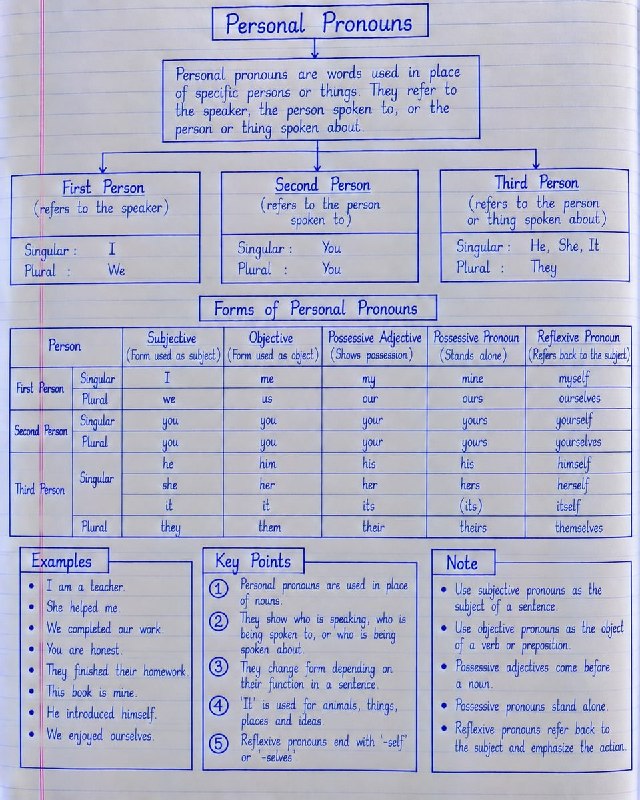
English Language & Grammar
22 Sept, 12:56
A curated list of 100 concise words has been compiled to assist in expressing ideas clearly and efficiently. This selection is intended to help individuals communicate with precision and brevity across various contexts.Each word on the list has been chosen for its ability to convey meaning effectively, reducing the need for lengthy descriptions. Such vocabulary supports clear and direct communication.These words are suited for both personal and professional use. They provide a valuable resource for anyone looking to enhance the impact of their language through simplicity and accuracy.🏴 Our channels

English Language & Grammar
22 Sept, 12:56
The core distinction between "Miss," "Mrs.," "Ms.," and "Mr." relates to gender and marital status."Miss" is used for an unmarried woman. "Mrs." identifies a married woman. "Ms." is applied to a woman regardless of whether she is married. "Mr." is used for men without specifying marital status.These forms of address indicate social titles rather than job titles or qualifications. They are commonly used in formal communication, correspondence, and introductions.🏴 Our channelsEnglish Language & Grammar
21 Sept, 08:55
A preposition is a grammatical element used to link nouns, pronouns, or phrases to other words within a sentence. It typically indicates relationships such as direction, location, time, or method.Common examples include “in,” “on,” “at,” “by,” and “with.” Prepositions clarify the connection between different parts of a sentence and help convey precise meaning.Their placement often comes before a noun or pronoun, emphasizing the relationship between these terms and other components in the structure of the sentence.🏴 Our channels
English Language & Grammar
21 Sept, 08:55
Avoid using “very” in languageConcise vocabulary enhances clarity. Replacing phrases such as “very cold” with “freezing” or “very tired” with “exhausted” strengthens expression.Alternative adjectives provide more specific descriptions. “Very small” may be replaced with “tiny,” while “very hungry” can be simplified to “starving.”Precise word choice is encouraged in formal settings or academic communication. Removing unnecessary intensity words results in clearer, more effective language.🏴 Our channels
English Language & Grammar
20 Sept, 09:38
🏴 Our channels
English Language & Grammar
20 Sept, 09:38
The phrase “knock on wood” is commonly used to ward off bad luck after making a hopeful statement. Its origins are uncertain, but some researchers link it to ancient European traditions where people believed spirits resided in trees. Tapping or touching wood was thought to invoke protection from these spirits.Today, the expression remains part of everyday language. It is typically said after mentioning good fortune or a positive expectation, serving as a superstition to prevent a reversal of luck. The phrase continues to be recognized in both casual conversation and formal contexts.🏴 Our channels
English Language & Grammar
20 Sept, 09:38
🏴 Our channels
English Language & Grammar
19 Sept, 09:21
Prepositions are essential elements in English grammar, used to indicate relationships between different words within a sentence. They often describe location, direction, time, or method.Common examples include “in,” “on,” “at,” “by,” and “with.” Usage of prepositions varies based on context, and incorrect application can alter the meaning of a sentence.Understanding how prepositions function is necessary for constructing accurate and clear sentences in both written and spoken English.🏴 Our channels
English Language & Grammar
19 Sept, 09:21
A new compilation has been published detailing 100 adverbs regarded as essential for educated adults. The list aims to highlight a range of adverbs that are widely used in formal writing and public discourse.These adverbs were selected to support effective communication, improve clarity, and enhance written and spoken expression. The compilation includes both frequently encountered and more specialized adverbs, chosen for their relevance and utility.This resource is intended for individuals seeking to expand their vocabulary and refine their language skills. The selection reflects current standards in education and professional communication.🏴 Our channels
English Language & Grammar
19 Sept, 09:21
The phrase “in a pickle” refers to being in a difficult or troubling situation. Its origin dates back to the 16th century, when “pickle” described a spicy or salty solution used for preserving food. Over time, English speakers began using the term figuratively to describe someone stuck in a challenging predicament. Historical records indicate the phrase appeared in literary works, including those by William Shakespeare, illustrating its longstanding presence in the language. Today, “in a pickle” is still commonly used to express that someone is facing a problem or complication.🏴 Our channels
English Language & Grammar
18 Sept, 06:49
🏴 Our channelsEnglish Language & Grammar
18 Sept, 06:48
🏴 Our channels
English Language & Grammar
18 Sept, 06:48
The distinction between “equivocal” and “ambiguous” concerns the nature of uncertainty in language. “Equivocal” describes wording that can be interpreted in several specific ways, typically because it intentionally has more than one possible meaning. In contrast, “ambiguous” refers to statements or expressions that are unclear or have multiple possible meanings, often unintentionally. This difference highlights the importance of precise language, especially in legal, academic, and professional contexts. Accurate use of these terms can help minimize misunderstandings and improve communication clarity.🏴 Our channels
English Language & Grammar
17 Sept, 12:01
The terms "perspective" and "prospective" are often confused due to their similar spelling. Perspective refers to a particular viewpoint or the way something is observed or considered. It is used when describing an attitude, opinion, or visual angle.Prospective, on the other hand, pertains to something expected in the future. It is commonly used to describe someone or something likely to become part of a specific situation or to refer to future possibilities.Understanding the correct usage of these terms is important for precise communication.🏴 Our channels
English Language & Grammar
17 Sept, 12:01
🏴 Our channelsEnglish Language & Grammar
16 Sept, 08:32
🏴 Our channelsEnglish Language & Grammar
16 Sept, 08:31
The phrase “in a jiffy” refers to something happening very quickly or in a short amount of time. Originally, “jiffy” appeared in English during the late eighteenth century, and its exact origins remain uncertain. Some sources suggest it may have started as slang for a brief moment.Over time, “in a jiffy” became a common idiom used to emphasize speed or promptness. The term continues to appear in both spoken and written English, often indicating an action will occur with minimal delay.Historically, “in a jiffy” has been widely used in various contexts, from everyday speech to literature, maintaining its meaning throughout modern usage. No substantial changes to its definition have occurred since its introduction.🏴 Our channels
Related Channels
Other channels in the same section of the catalogue.