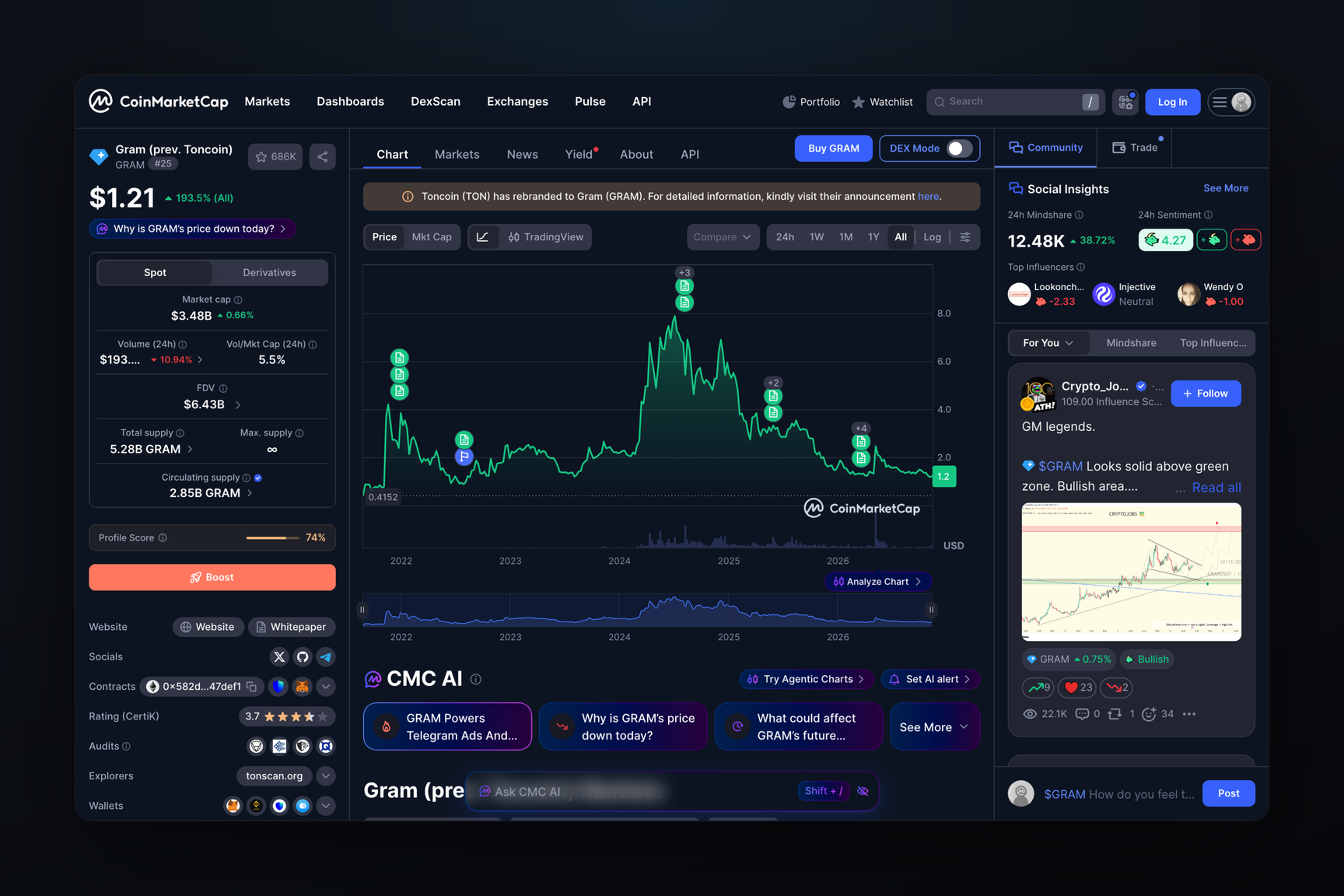
On November 9, Gram dropped below $1. On Binance the price first slipped under a dollar at 07:46 UTC, bottomed at $0.992 at 08:11 and did not go below a dollar again after 08:17. The last time Gram closed a day under a dollar was August 4, 2022. The same day Pavel Durov wrote that more than 700,000 wallets had been created in Telegram in 48 hours. The counter on the gram.org explorer logged 718,344 new addresses over those two days, and 94% of a sample of 1,188 addresses forwarded the incoming transfer with their very first outgoing transaction. On November 12, Gram trades at $1.22, and new addresses are appearing seven times slower than a day earlier.
What Gram costs
| GRAM · Gram | At publish 9 Nov 2026 |
|---|---|
| Price | $0.992 |
| Market cap | $2.83B |
| Supply | 2.85B |
Figures recorded by the newsroom on the dates shown.
The price had been sliding since late October: the day closed at $1.31 on October 22, at $1.18 on November 4 and at $1.02 on November 8. On November 9, between 07:46 and 08:17 UTC, the price dipped below a dollar several times, for 26 minutes in total, and the day closed at $1.04. Then it went up: on November 11 it reached $1.257 on Binance, and on November 12 at 14:23 UTC it stood at $1.218.
| Date | Gram | What it is |
|---|---|---|
| June 15, 2024 | $8.24 | all-time high |
| November 12, 2025 | $2.01 | a year ago, daily close |
| October 12, 2026 | $1.36 | a month ago, daily close |
| November 9, 2026 | $0.992 | low, Binance, 08:11 UTC |
| November 12, 2026 | $1.22 | Binance, 14:23 UTC |
From the June 2024 high to the November 9 low, the price fell 88%. Over the month Gram lost 10%, over the year 39%. Bitcoin lost 12% and 29% over the same month and year, ether 19% and 42%.
Trading volume grew with the rebound. According to CoinMarketCap, Gram traded $40 million on November 1, $90 million on November 9, $182 million on November 10 and $221 million on November 11.
Since June 2026 the coin has been called Gram; before that it was Toncoin, and exchanges list it under the GRAM ticker.
When Gram last cost less than a dollar
In the summer of 2022. From June 13 to 19 and from July 12 to August 4, Gram closed the day below $1, the lowest being $0.82 on June 18. On August 5, 2022 the day closed at $1.04, and since then not a single day has ended below a dollar, November 9, 2026 included.
Once in those four years the price did fall under a dollar within a day. On October 10, 2025, between 21:19 and 21:23 UTC, Gram (still Toncoin back then) traded as low as $0.554 on Binance, was back above a dollar five minutes later and closed the day at $2.04. The whole market was falling that evening: bitcoin on Binance went from $121,662 down to $102,000 within the day. Leaving those five minutes aside, November 9, 2026 was the first time Gram cost less than a dollar since August 2022.
How many wallets were created
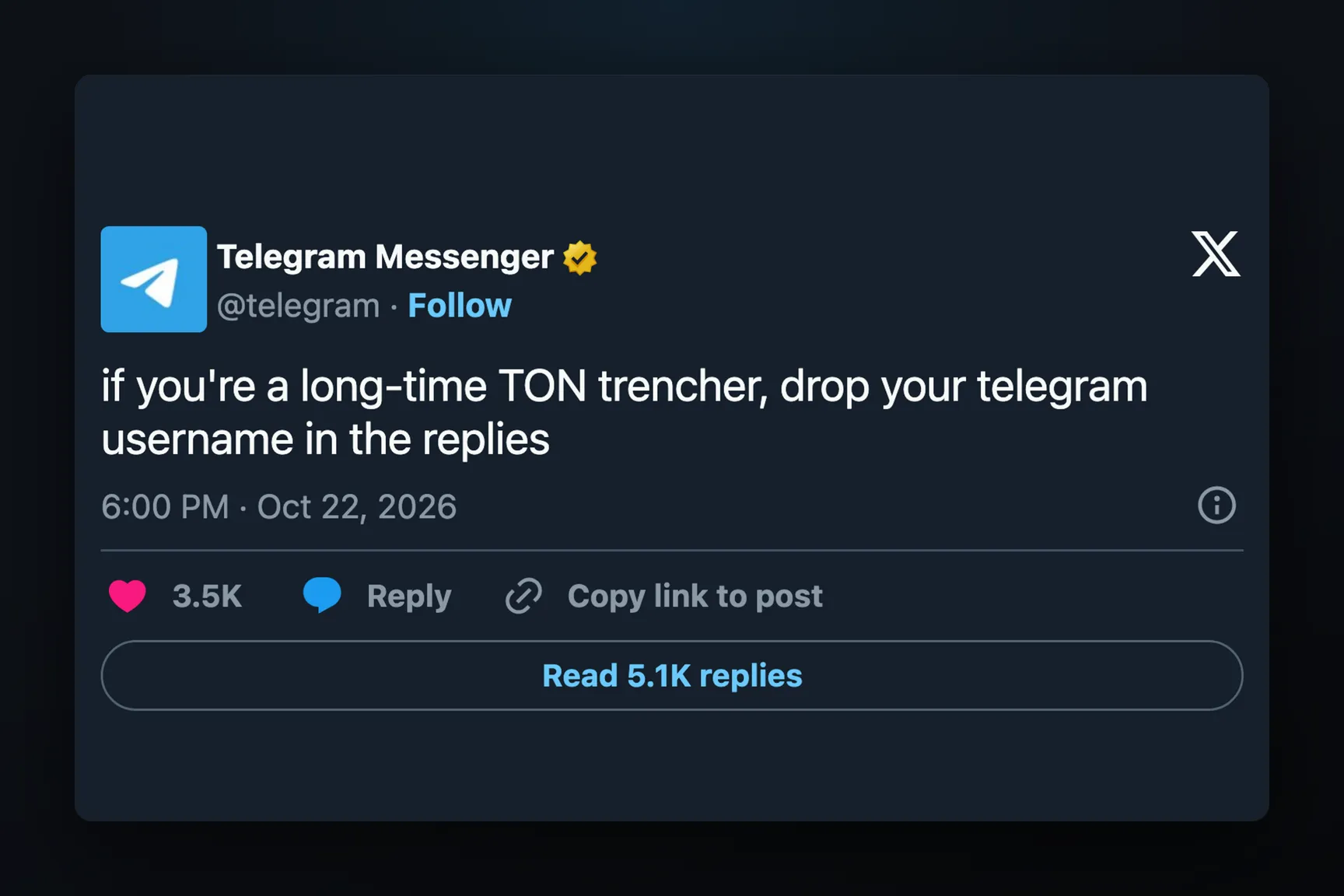
The post went out on November 9 at 13:00 UTC. A wallet, Durov writes, "activates the moment someone receives Grams".
The counter is published by the gram.org explorer. It counts users who have a wallet address attached to their profile, even if that address has not had a single transaction yet. A snapshot of the counter taken at 12:58 UTC, two minutes before the post, shows 718,344 new addresses over 48 hours and 2,375,694 addresses in total. A profile has an address even before its first transfer, and you can find it right in Telegram.
| Day, UTC | New addresses |
|---|---|
| November 7 | 209,973 |
| November 8 | 246,621 |
| November 9 | 538,279 |
| November 10 | 614,906 |
| November 11 | 302,461 |
For comparison, 73,154 addresses appeared on November 1 and 203,935 on November 3. A typical hour in the two days before the post brought about 8,500 addresses, but some hours brought six to nine times as many: 56,934 from 23:00 on November 7, 68,575 from 04:00 on November 8, 52,321 from 19:00 on November 8, 78,533 from 06:00 on November 9. On November 12 at 14:23 UTC there were 3,536,270 addresses, 189,571 of them with a non-zero balance.
The on-chain count is stricter: it treats an address as a wallet once at least one transaction has gone through. According to the Gram Wallet dashboard, there were 645,966 such wallets at the end of November 7, 1,786,367 at the end of November 10 and 2,007,646 on November 12. The built-in wallet has been rolling out to all users since October 9, and since October 21 gifts can be moved into it from the profile.
What the new wallets look like on-chain
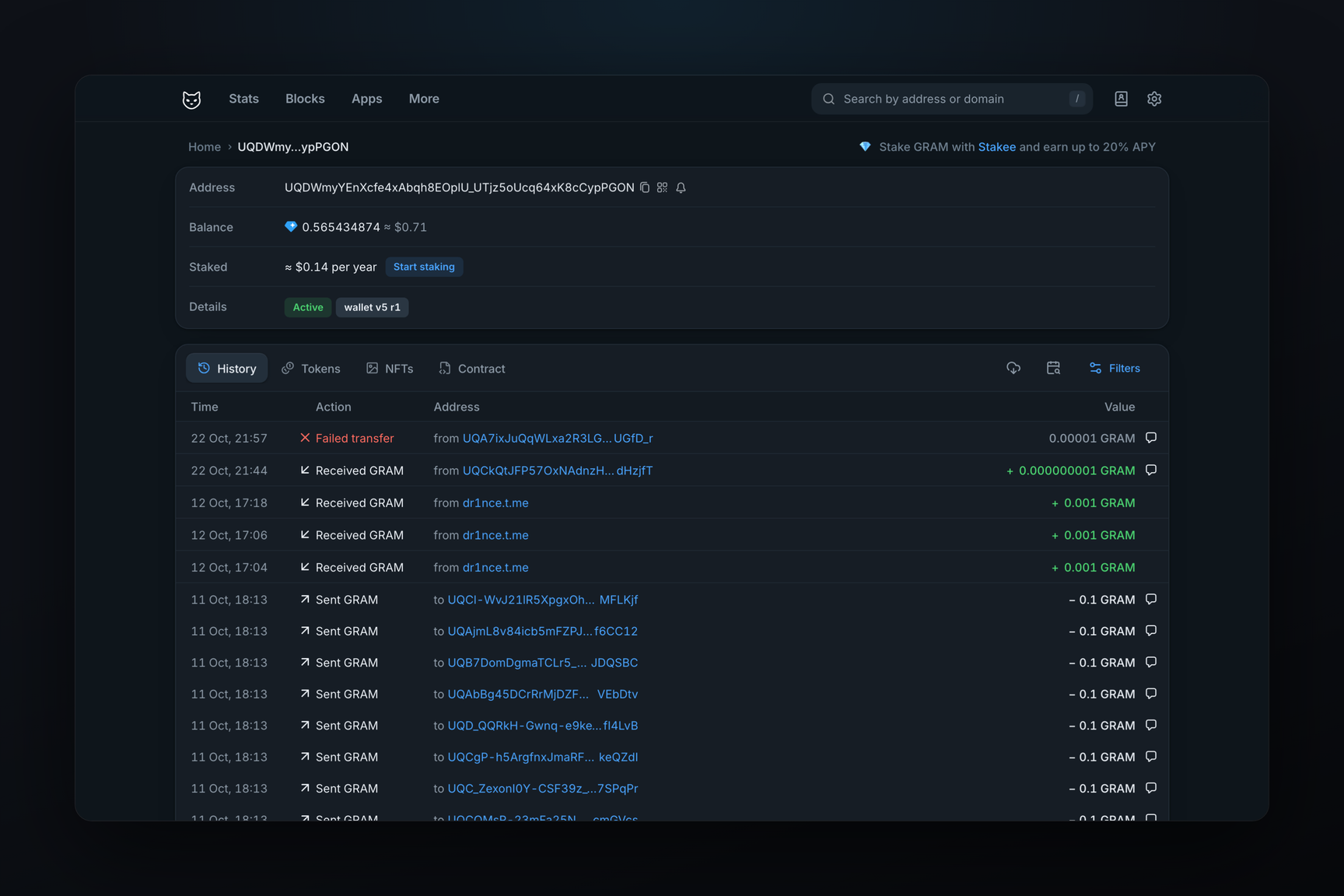
The gram.org explorer shows the twelve most recently created addresses. For this article, snapshots of that list were taken every half hour over the 48 hours before Durov's post, 1,188 addresses in all, and the first transactions of each were read. The sample is not random: it includes the addresses created at the moment of a snapshot, and hours of surges are overrepresented in it. 1,115 of them, 94%, started the same way: they received a transfer from another address and with their very first outgoing transaction passed on at least 90% of what they had received. 814 did it in a single transfer, 301 split the amount into parts, from two to 255 transfers. The amounts were small: in 97% of cases no more than 1 Gram, with a median of 0.2 Gram. Half of the time less than eight minutes passed between receiving and sending, 87% of the time less than an hour. 20 addresses had no transactions at all, 43 had only an incoming one.
The money converges on a handful of addresses. 382 addresses in the sample, almost a third, sent everything to one and the same address, 138 to a second one, 71 to a third, together half of the sample. The first two are ordinary W5 wallets, the third is a Telegram wallet itself.
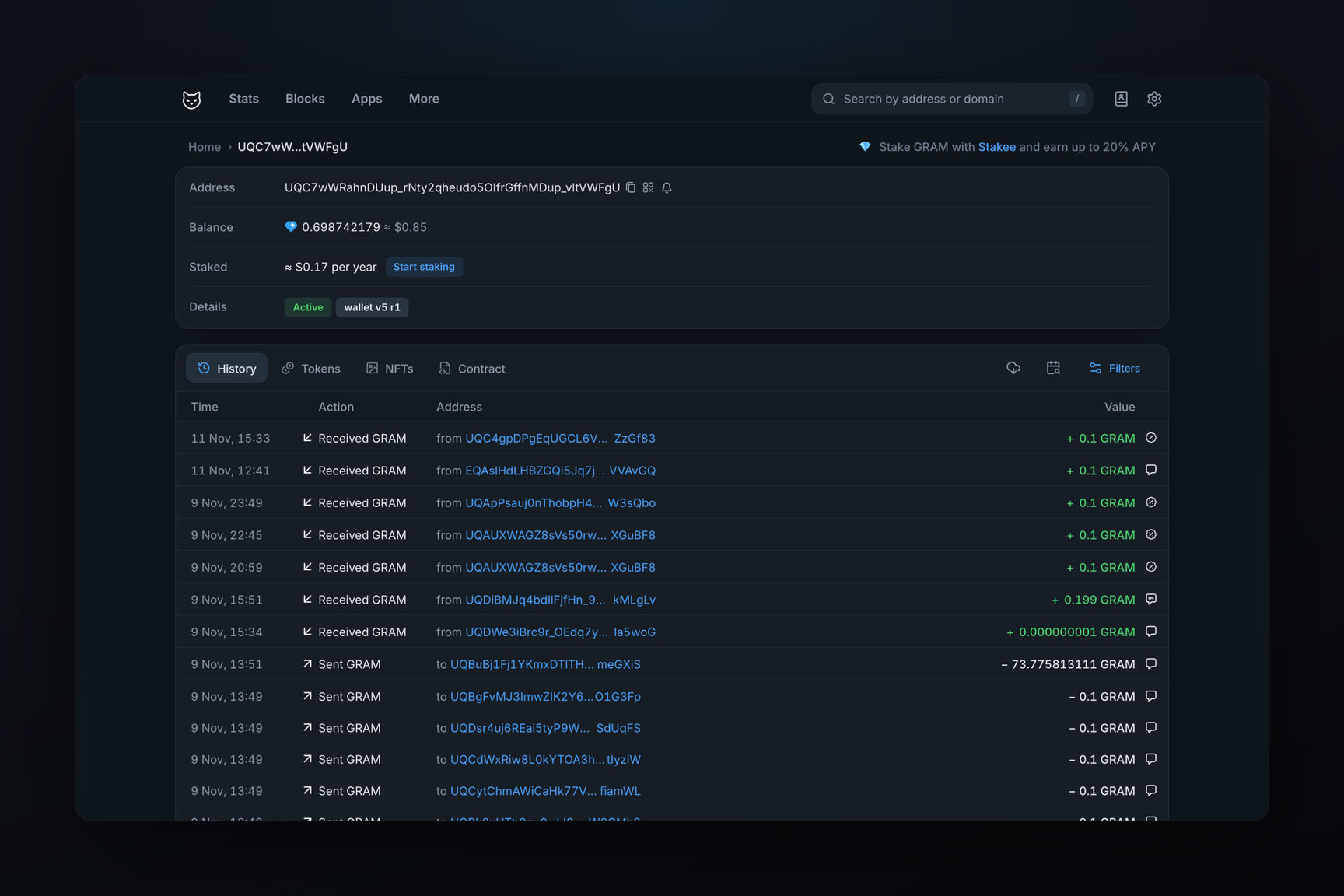
How one such loop works can be seen on the largest of these addresses. On November 9 it received 25.367 Gram from a Telegram wallet every four minutes. At 12:52:37 UTC it sent 25.71 Gram to a new address that had not existed on the network before. Twelve seconds later this Telegram wallet sent out 250 transfers of 0.1 Gram each with an ad for a Chinese gaming service in the comment, five more 43 seconds later, and returned the remaining 0.157 Gram. All twenty checked recipients of this mailing were addresses that first appeared on the network in that same minute. All twenty forwarded 0.099 Gram each to one and the same address at 12:59.
The blockchain does not show who is behind these wallets. It shows something else: a transfer arrives at an address that did not exist on the network yet and a few minutes later leaves it in full, together with hundreds of others just like it. In October, mass mailings to Telegram wallets worked the same way, as 0.1 Gram transfers with an ad in the comment, and cost the senders thousands of Gram. A transfer with an ad takes nothing from the recipient's balance, and it is best not to open the links in such comments.
What happened after November 11
The pace dropped overnight into November 12. From 02:00 to 14:00 UTC addresses appeared at an average of 1,822 an hour, ranging from 608 to 4,226. A day earlier, the same hours saw 13,764 an hour, and November 10 averaged 25,600 an hour over the day.