TON validators have voted for a network update: as of October 22, the blockchain configuration includes global version 16 and the second version of the consensus protocol. This primarily changes how nodes distribute blocks and manage message queues. The global Gram balance validation, which was cited as a goal of the vote, will only be enabled by code in the next, 17th version.
What Changed in the Configuration
TON network rules are recorded in the blockchain configuration and are changed by validator votes. On October 21, starting at 06:00 UTC, validators voted on two proposals: to raise the global version (config parameter 8) to 16 and to switch the consensus (config parameter 30) to its second version. As of October 22, config parameter 8 shows version 16 — tonapi confirms this — and config parameter 30 shows the second version of the consensus protocol. There are no more open proposals in the configuration.
The global version is a number that all nodes use to simultaneously enable new block processing rules. The code for these rules is delivered in advance with node software updates, but it only becomes active when the network votes for the specific version number.
What Version 16 Includes
According to the documentation for global versions:
- Shard outgoing message queue is limited. A shard is a part of the blockchain processed by its own group of validators. By default, the hard limit is 18,000 messages, and the soft limit is 12,000; config parameter 43 can override these. Excess messages wait in the dispatch queue, and a shard with a queue exceeding half of the hard limit will not request a merge with a neighboring shard.
- Accounts with a fixed prefix can be unfrozen. Previously, an account with a non-zero fixed prefix length of the address, once frozen for unpaid storage fees, could not be unfrozen — this has been corrected.
- The total amount of coins in its messages has been added to the dispatch queue data, and proofs in block collator data now have a new format.
Balance Validation — In Version 17
The voting announcement linked version 16 to automatic global balance validation. According to the code, this validation will be enabled later: in block validation, the condition is global_version_ >= 17, and the commit merged on October 7 is titled "Enable global balance validation in version 17". Version 16 only prepares the data for it: it starts storing the sum of messages in the queue. In the documentation, the validation is also attributed to version 17.
What exactly will be validated: the masterchain state — the main chain that consolidates all shards — contains a global_balance.grams field, representing the total balance of coins across the entire network. In version 17, masterchain validators will begin to verify this number. Grams is the name of the coin in the protocol since the first TON code, and it is still used in the description of block structures. Voting for version 17 has not yet been announced.
Second Version of the Consensus Protocol
The second version of the consensus, according to the announcement, includes block distribution using the Plumtree scheme in the public overlay. The public overlay is a common network through which new blocks are received by nodes not participating in validation. In the Plumtree scheme, nodes form a tree: the block travels entirely along its branches, while only a short notification that the block exists is sent to other neighbors. This reduces the number of identical block copies circulating in the network.
The scheme itself is not new: it was enabled with the 2026.06 release, and the previous distribution method was disabled in August. Now it has also arrived in the public overlay due to an issue: since September 23, many nodes appeared there that do not forward traffic further, and block and external message delivery via the overlay deteriorated. Plumtree, according to the team, delivers more reliably, even with many such nodes.
Large services — exchanges, wallets, Telegram, and Toncenter — do not use the public overlay, according to the network team's statement. This change primarily affects those who run their own full node.
What Else Is In The Node Update
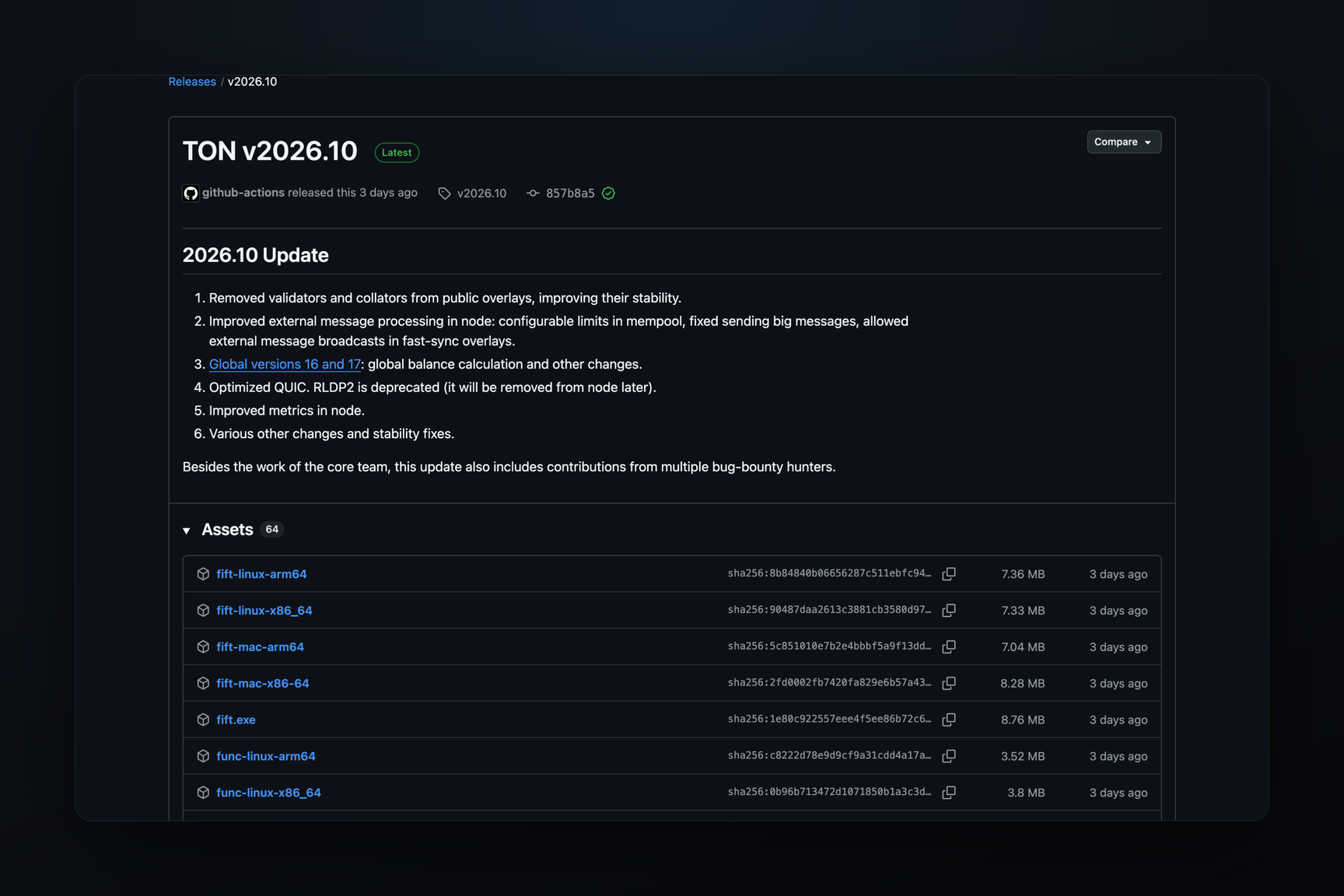
The vote was preceded by the release of node software v2026.10 on October 19. In addition to the code for versions 16 and 17, it includes:
- Validators and block collators have been removed from public overlays.
- The external message mempool — for messages coming into the network from wallets and services — now has configurable limits, and the sending of large messages has been fixed.
- The QUIC protocol has been optimized, and the previous RLDP2 transport has been declared deprecated and will be removed from the node.
The update is mandatory: validators were given 24 hours after the release, and full node owners until Friday, October 23, by which time the QUIC port must be operational on the node.