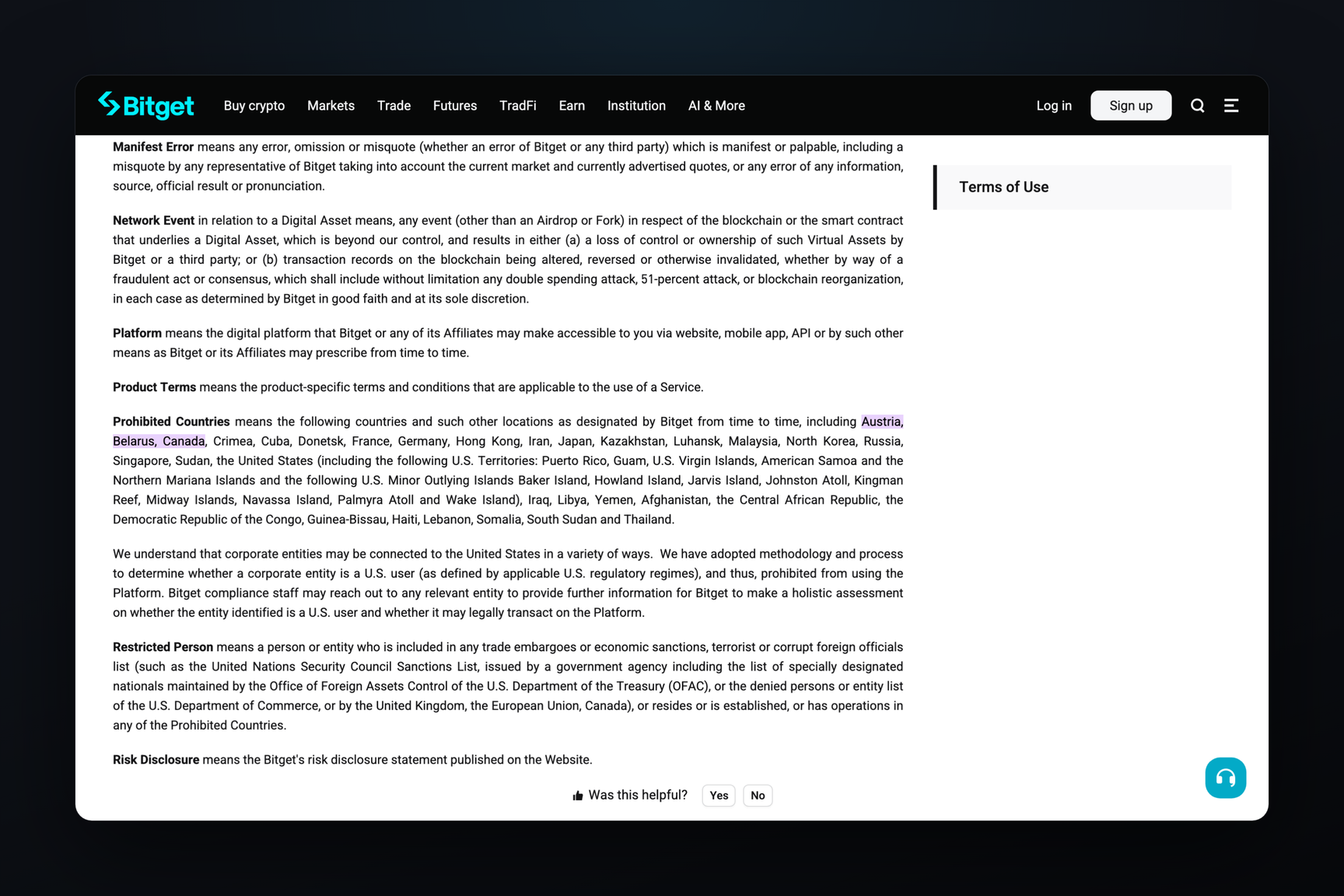
On October 16, Bitget updated its Terms of Use and added Russia and Belarus to the list of countries whose residents the exchange does not serve. Kazakhstan was already on this list. Bitget's TON network addresses currently hold approximately $6.4 million in GRAM and TON jettons — these are the funds of all the exchange's clients on this network, not just users from Russia.
What Changed in the Terms of Use
The current version of the terms, dated October 16, 2026, includes a section on Prohibited Countries — countries from which the exchange cannot be used. Russia and Belarus appeared in it for the first time. In the September 15 version, which the Wayback Machine saved on October 12, they are not yet present, while Kazakhstan, Germany, France, Austria, Canada, the United States, and Hong Kong were already listed.
Adjacent in the terms is the definition of a Restricted Person: this includes individuals from sanctions lists, as well as those who reside, are registered, or conduct business in prohibited countries.
What Users from Russia and Belarus Should Do
The terms do not specify deadlines or procedures for withdrawing funds. If you hold GRAM or TON jettons on Bitget, you can withdraw them to your own wallet via a standard TON network withdrawal — for example, to the wallet built into Telegram or any other.
How Many TON Assets Are on Bitget
Bitget has fifteen addresses on the TON network, which tonapi's labeling identifies as exchange addresses. As of October 17, they hold:
| Asset | Amount | In USD |
|---|---|---|
| USD₮ | 3.52 million | $3.51 million |
| GRAM | 847,399 | $1.14 million |
| CATI | 16.6 million | $874 thousand |
| NOT | 711 million | $285 thousand |
| VERT | 133 million | $141 thousand |
| HMSTR | 803 million | $135 thousand |
| TAC | 82.4 million | $100 thousand |
| DOGS | 2.14 billion | $84 thousand |
Including other jettons, the total is approximately $6.4 million. Almost all GRAM is held across four of the fifteen addresses: from 87 to 290 thousand GRAM on each, while the remaining eleven addresses hold about a thousand or less. It is not possible to determine from the blockchain how much of these funds belong to clients from Russia and Belarus, as the exchange stores all user funds in common addresses.