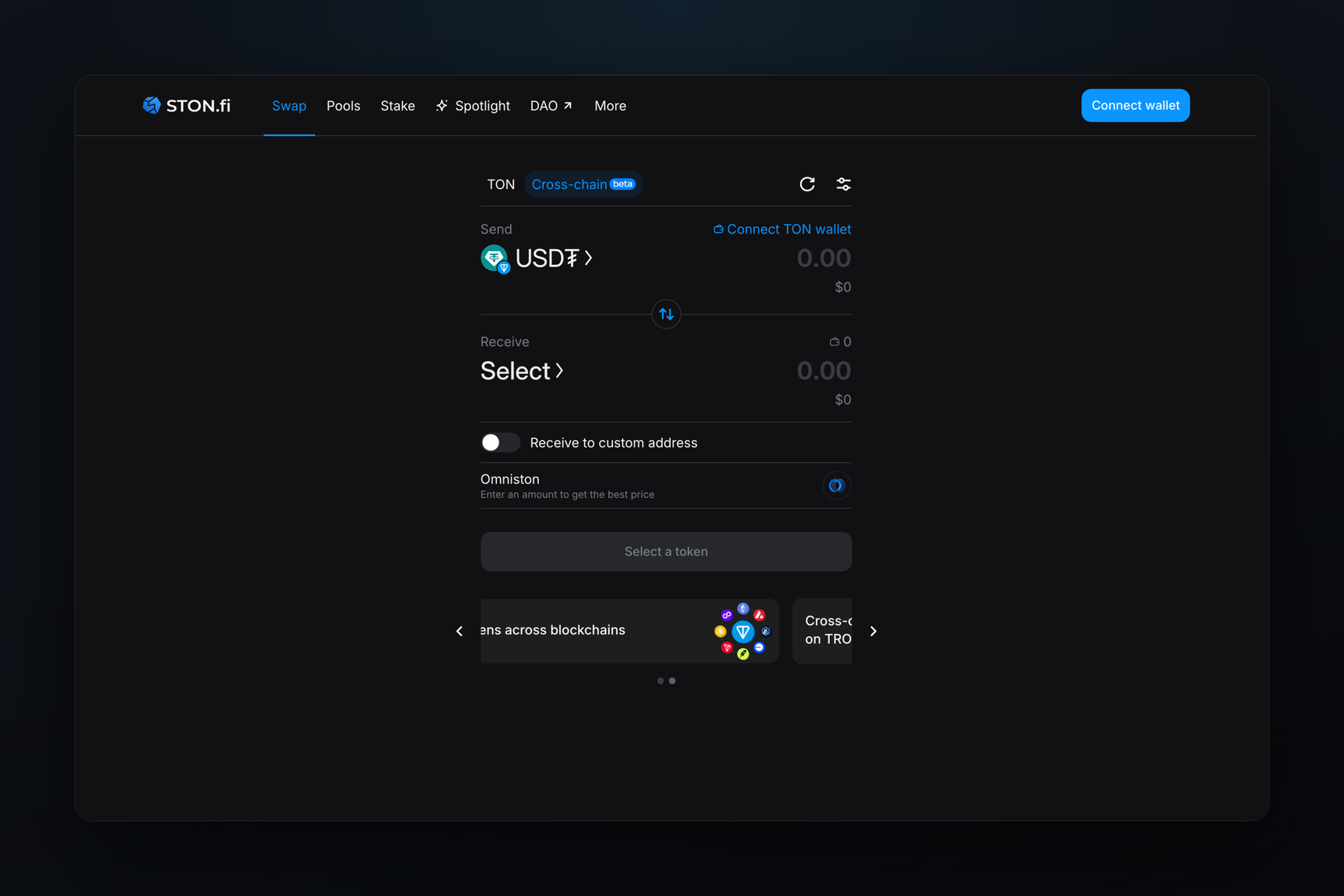
Since June 16, the STON.fi app, the largest DEX on TON, has allowed users to swap stablecoins between different networks: for example, USDT on TON for USDC on Base, or USDT on TRON for USDT on TON. This functionality supports swaps across 13 networks in total. By October 27, these swaps had processed $13.2 million, with 40,984 orders completed and approximately 94% of them executed. A single route, from BNB Chain to TON, accounted for $9.2 million, or 70%, of this turnover. This flow almost ceased on October 3. In addition to cross-chain swaps, STON.fi has released an open mini-app example, a log of STON and GEMSTON buybacks funded by fees, a bot course, and five new websites over the past six months.
How Cross-Chain Swaps Work
Swaps are executed by Omniston, a STON.fi protocol that previously sought the best price between DEXs within TON. In API version v1beta8, opened for testing on May 19, a second execution scheme, an order, was introduced. An order is filled by a resolver, which is a market maker with their own funds in both networks. The process, according to the documentation, is as follows:
- The application sends a quote request, and resolvers respond with a price and the amount the user will receive.
- The user locks their coins in the source network. On TON, this is a transfer to an escrow contract. In an EVM network, it's a signed order with token spending approval, and the transaction is sent to the network by the resolver.
- The resolver locks their coins in the destination network.
- Both locks are structured as HTLCs (Hash Time-Locked Contracts): coins are claimed by whoever presents the secret whose hash is recorded in the contract, and if the secret is not revealed by the deadline, the coins are returned to the owner.
- Once the resolver's position in the destination network is ready, the secret is revealed. The user receives the coins, and the resolver uses the same secret to claim the original side.
There is no bridge or intermediary custodian in this scheme: each network holds its native stablecoins, without an intermediate wrapped Omniston asset. An order has two possible outcomes: a complete swap or a refund via timelock. An order can be filled in parts: in the open mini-app example, the application generates four secrets for one order and reveals them as parts become ready. Swaps from an EVM network require no gas from the user; they only sign a message. From TON, gas is still required.
Order Timers
An order has four deadlines. The user must deposit coins within the quote's validity period. By the start deadline, coins must reach the contract or the order must be signed; after this, execution is at the resolver's discretion. During the exclusivity window, the chosen resolver is obligated to reserve the user's position and provide collateral. After the cancellation mark, the user can withdraw any unfilled remainder, and the exclusivity also ends at this moment. When the chosen resolver's closed completion window expires, another authorized resolver can complete the position. A public refund, available not only to the chosen resolver, only applies to the input position, i.e., the user's coins in the source network.
Only stablecoins are swapped. The list as of October 27:
| Network | Coins |
|---|---|
| TON | USDT |
| TRON | USDT |
| Ethereum, BNB Chain, Base, Avalanche | USDT, USDC |
| Arbitrum, X Layer | USDT0, USDC |
| Polygon | pUSD, USDT0, USDC |
| Robinhood Chain | USDG |
| Arc | USDC |
| HyperEVM, Plasma | USDT0 |
At launch, there were five networks: TON, Ethereum, Base, BNB Chain, and Polygon. Then Avalanche and Arbitrum were added on July 3, Robinhood Chain on July 17, TRON on July 21, X Layer on August 18, Arc on September 22, and HyperEVM and Plasma on October 1. Monad is also listed in the documentation, but there are no orders involving it in the protocol's history. In the application, swaps are limited to $1,000 per order; this was announced as a temporary measure at launch. This is an application ceiling, not a protocol one: on October 15, an order for $8,720 from pUSD on Polygon to TON was executed via Omniston. Since August 11, the recipient address can be entered manually without connecting a second wallet.
Cost and Waiting Time
The protocol fee for orders between October 12–26 ranged from 0.01% to 0.13%, most often 0.03%, and is withheld in the destination coin. Over its entire history, cross-chain swaps have generated $1,696 for the protocol, approximately 0.013% of turnover.
The primary cost is embedded in the resolver's quote. The price loss for orders between October 12–26:
| Route | Orders from $500 | Orders up to $50 |
|---|---|---|
| TON → Ethereum | 0.19% | 1.08% |
| Ethereum → TON | 0.20% | 1.21% |
| TON → BNB Chain | 0.22% | 0.65% |
| BNB Chain → TON | 0.25% | 0.60% |
| TON → Polygon | 0.15% | 0.65% |
| TON → Base | 0.14% | 0.55% |
| Arbitrum → TON | 0.14% | 0.58% |
Applications integrating Omniston can add their own fee on top: in the open mini-app example, it is set at 10,000 pips, which is 1%.
The stated time for most swaps is 15–40 seconds. From order creation to completion for orders between October 12–26, the median was 11 seconds from BNB Chain and Arbitrum to TON, 12–17 seconds from TON to BNB Chain, Base, and Polygon, and 29–32 seconds between TON and Ethereum. Nine out of ten orders were completed within a minute. Between 8% and 16% of orders on different routes ended without execution; in such cases, the locked funds are returned after the timelock, according to HTLC rules.
Who Executes Orders
Historically, there has been effectively one resolver in the protocol. Of the $13.19 million cross-chain turnover, $13.14 million, or 99.6%, was executed by the resolver identified in the order history as Arbiter. Connecting other resolvers is described in the documentation: registration, authentication, and a quote stream, with the resolver providing its liquidity in the destination network.
Turnover Origin
| Month | Cross-Chain Turnover | Completed Orders |
|---|---|---|
| June | $173,583 | 3,079 |
| July | $764,925 | 7,586 |
| August | $1,619,892 | 4,824 |
| September | $8,340,160 | 16,600 |
| October 1–26 | $2,293,708 | 8,895 |
Almost all growth came from the BNB Chain to TON route: until August 17, its weekly share was about 1%; in the week of August 17, it rose to 51%, then to 77–88%. The flow was consistent. From September 15 to October 14, it was generated by 358 wallets, with the largest ones repeating orders for the application's maximum of $1,000 hundreds of times: 348 orders totaling $347 thousand from one address, 292 orders totaling $290 thousand from another. On October 1, $531 thousand passed through the route, $270 thousand on October 2, and $9 thousand on October 3. The reason for this was not publicly stated.
STON.fi's “One Swap. Across Chains” campaign, offering miles and prizes for swaps, ran from September 15 to October 26. This means the flow from BNB Chain started before it and ended earlier. After October 3, cross-chain turnover has remained at $0.36–0.42 million per week, and about 14% of the turnover in the last 30 days occurred entirely without TON, mainly between Avalanche and X Layer in both directions.
STON and GEMSTON Buybacks from Fees
The STON.fi DAO voted from December 27, 2025, to January 10, 2026, to spend up to 50% of protocol fees, currently in TON and USDT, on buying STON and GEMSTON from the market into the treasury; the remainder goes to development and infrastructure. Ston Foundation opened a log of these purchases on June 2 on a separate website.
As of October 27, 14:00 UTC, the log shows 6,604 conversions totaling $702 thousand:
| Token | Purchased | Spent | Average Price | Price October 27 |
|---|---|---|---|---|
| STON | 802,129 | ≈ $362 thousand | $0.451 | $0.478 |
| GEMSTON | 4,165,826 | ≈ $340 thousand | $0.082 | $0.083 |
The treasury address holds 783,092 STON and 4,063,179 GEMSTON. Wallets and conversion contracts hold an additional 19,036 STON, 102,647 GEMSTON, and approximately 119 thousand USDT. Purchases are made in small batches, on October 27, at $36–99 per transaction. The future fate of the purchased tokens is decided by the DAO through a separate vote.
Volumes and Liquidity
STON.fi's pools held $22.5 million as of October 27. Six months ago, on April 27, it was $24.7 million. The maximum for the past six months was $41.9 million on May 8, and the all-time high was $373 million on July 31, 2024. Turnover for swaps within TON:
| Month | Turnover |
|---|---|
| May | $331 million |
| June | $150 million |
| July | $110 million |
| August | $77 million |
| September | $84 million |
| October 1–26 | $58.4 million |
Over the last 30 days, this amounts to $82.1 million, representing 65.5% of the total turnover of all DEXs on TON. This is followed by TONCO V2 with 19.5% and DeDust with 13.7%.
Other Releases in the Last Six Months
For developers, in addition to the v1beta8 sandbox, an open-source example of a mini-app was released: the repository was created on September 16, with the announcement on the 23rd. Users only connect a TON wallet via TonConnect; an EVM wallet is created for them behind the scenes by the Dynamic service, and Omniston transfers USDT from TON to USDT0 on Arbitrum and back. The authors state that this is an integration example, not a ready-to-use application. This scheme is already used by Predict with Polymarket and WenLong. The old API v1beta7 was deprecated on October 1.
On July 16, the STON.fi bot launched the STONfi.pools course: covering theory and practice exchanges, liquidity, farming, and staking in a sandbox environment, without needing a wallet or real funds, and concluding with a certificate.
In addition to the application, as of October 27, STON.fi operates eleven websites and pages. Six of these were launched in the last six months, while five were opened before April 27:
| Website | Description | Launched |
|---|---|---|
| transparency.ston.foundation | STON and GEMSTON buyback journal | June 2026 |
| cross-chain.ston.fi | "One Swap. Across Chains" campaign | September 2026 |
| stoncat.com | Stoncat NFT mascot, upgraded with GEMSTON | September 2026 |
| whatisdex.com | "What is DEX" educational website | September 2026 |
| stonverse.com | STON.fi courses and games showcase | October 2026 |
| stonverse.com/cybersecgame | Game about crypto scam schemes | October 2026 |
| tondefi101.com | DeFi on TON course, opens on ton101.com | April 2026 |
| ston.fm | 24/7 AI-generated music radio with a Pomodoro timer; previous address radio.ston.fi | October 2025, ston.fm address since May 2026 |
| tools.ston.fi/apy-calculator-apr | APR calculator | December 2025 |
| tools.ston.fi/impermanent-loss-calculator | Impermanent loss calculator | October 2024 |
| stoncatadventure.com | "DEX vs CEX" game | December 2024 |
The impermanent loss calculator was already available on October 31, 2024, and the APR calculator since December 18, 2025. In July, STON.fi gathered the calculators on a single page. The domains stoncat.com and whatisdex.com were registered in 2024 and were still placeholders in summer 2025.