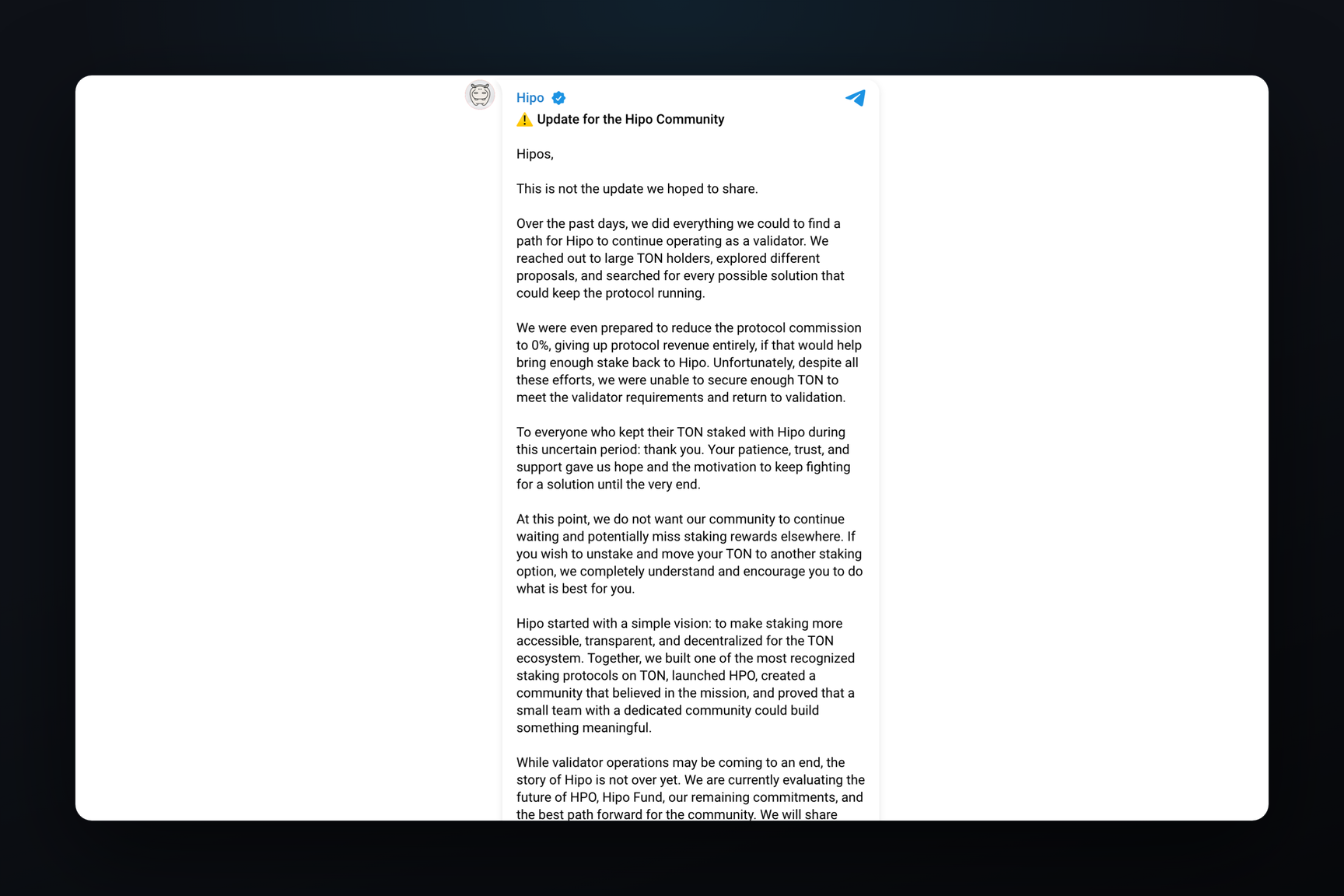
From May 30 to June 5, the Hipo liquid staking protocol missed nine consecutive TON validation rounds. Following a large withdrawal, its treasury held approximately 600,000 GRAM, hitting a low of 571,127 GRAM on June 5. On June 6, the team bid farewell to its stakers, only to send a stake back into validation less than eight hours later. As of October 27, the protocol treasury contract holds 10,317,600 GRAM, an 18-fold increase from its lowest point. This affects approximately 23,200 addresses holding hGRAM, Hipo's staking token.
How Hipo Works and Why It Needs a Threshold
Hipo accepts GRAM into its protocol treasury contract and issues hGRAM in return. Rewards are not distributed separately but accrue to the hGRAM exchange rate. According to the contract descriptions, the treasury contract tracks two amounts: the total GRAM in the pool and the total hGRAM issued. Rewards increase the former, while the latter remains constant, meaning each hGRAM becomes worth more GRAM over time. On October 27, one hGRAM was worth 1.18974 GRAM.
The treasury contract itself does not validate. Each validation round, it issues the pool as a loan to validators. For each loan, a separate contract is deployed on the masterchain, from which coins cannot be withdrawn; they can only be sent as a stake to the elector, the system's election contract. After the round, the loan returns to the treasury contract along with the reward. Validation rounds overlap, with a new one starting approximately every 18 hours.
The formal minimum stake in the network is 300,000 GRAM (configuration parameter 17). The effective threshold is higher: there are no more than 400 validator slots, and the elector discards small stakes if their inclusion would result in a lower total effective stake for the set. On October 27, there were 382 validators in the set, and the smallest elected stake was 785,727 GRAM.
Why 300,000 is not enough
The elector sorts applications by size and calculates the sum of stakes for each possible number of validators. A stake that is 4.5 times or more greater than the minimum in the set is only counted up to this ceiling (max_stake_factor parameter, 294,912/65,536). The set with the largest sum of counted stakes is chosen. A small application lowers the ceiling for all large ones, so the elector does not select it, even if it is above the formal minimum.
How the Pool Emptied
Until the end of May, the treasury contract lent out about a million GRAM each round: on May 29 at 06:01 UTC, 1,020,294 GRAM were issued as a loan, and on May 30 at 11:52 UTC, 1,021,018 GRAM returned. In the same minute, the treasury contract paid out 416,864 GRAM for a single withdrawal, leaving 604,726 GRAM in the pool.
From the validation round on May 30 (18:25 UTC) to the round on June 5 (20:05 UTC), the treasury contract passed the loan issuance point nine times consecutively without issuing any loans. On June 1, the team announced that approximately one million GRAM was needed to participate in elections under current network settings. Meanwhile, the pool continued to shrink: 585,466 GRAM on June 2, 578,078 GRAM on the night of June 5, and 571,127 GRAM on the evening of June 5.
Three Days Until Closure
On June 3, the team revealed that a large holder was willing to deposit enough GRAM if their stake was exempt from fees. In return, they would receive half of the protocol's revenue previously distributed among HPO governance token holders. Without this deal, the post stated, the protocol might have to cease operations. HPO holders voted in favor, but the required volume was still not met.
On June 6 at 06:27 UTC, the team published a farewell post: the necessary volume could not be raised, stakers were advised to withdraw GRAM to other protocols, and the future of HPO and Hipo Fund was promised to be decided separately.
At 10:36 UTC on the same day, the team announced that stakers had increased the pool to approximately 800,000 GRAM. The post mentioned that the chances of being elected had improved due to new network parameters. The protocol's commission was set to zero: all rewards would go to stakers. At 14:15 UTC, the treasury contract issued a loan of 800,748 GRAM. On June 7 at 20:07 UTC, it returned with 801,327 GRAM, an increase of 578 GRAM, meaning the stake was elected.
How the Pool Grew to 10 Million
The pool grew in surges, with almost every surge attributed to a single address. The volume in the treasury contract, GRAM:
| Date | In Treasury | What Happened |
|---|---|---|
| June 5 | 571,127 | minimum |
| June 6 | 800,385 | first loan after break, 800,748 |
| June 11 | — | loan at 03:29 UTC for 1,067,106, again over a million |
| July 7–8 | 3,979,935 | one address deposited 1.5 million |
| July 17–18 | 2,055,673 | one withdrawal of 2,038,506 |
| August 3–4 | 8,246,686 | multisig wallet deposited 5,717,000 |
| September 7 | 7,006,719 | one million withdrawn in 24 hours |
| October 25–26 | 9,911,145 | same address as in July deposited 1,950,000 |
| October 27 | 10,317,600 |
The team announced the 4 million GRAM milestone on July 10, a month after returning to validation. A week later, the pool shrank back to two million. The withdrawal on July 17 at 06:44 UTC occurred mid-cycle: loans for the July 16 round were calculated based on the previous 4 million, resulting in an annualized yield of 37.66% for that round, after which one round passed without participation.
The largest hGRAM holder is a multisig wallet. It holds 4,122,835 hGRAM, approximately 4.9 million GRAM at the current rate, or 47.5% of the pool. Together with the second-largest address, this totals 66.5%.
Source of Yield
The annualized yield for hGRAM is 16.01%, with a 30-day average of 16.94%.
The protocol's commission in the treasury contract remains zero. There is another fee—the borrower's payment: half of the reward that the validator keeps goes towards buying back and burning HPO. The stakers' income itself is determined by an auction: validators who wish to borrow the pool compete with their promised payout, and the winner may promise more than the network pays per round. The promise is secured by the borrower's collateral, and any loss exceeding the collateral, according to the contract descriptions, is recorded in a separate deficit counter. On October 27, this counter was zero.
Position Among TON Liquid Staking Protocols
According to aggregator data on October 27, 12:32 UTC, Hipo holds $12.65 million. This places it third among liquid staking protocols on the TON network:
| Protocol | TVL | Share |
|---|---|---|
| Tonstakers | $178.3 million | 78.7% |
| Stakee | $26.1 million | 11.5% |
| Hipo | $12.65 million | 5.6% |
| KTON | $7.5 million | 3.3% |
| Bemo (v1 and v2) | $2.1 million | 0.9% |
At its lowest point on June 5, Hipo had less than $0.9 million. The price of the hGRAM token can be found on the token page.