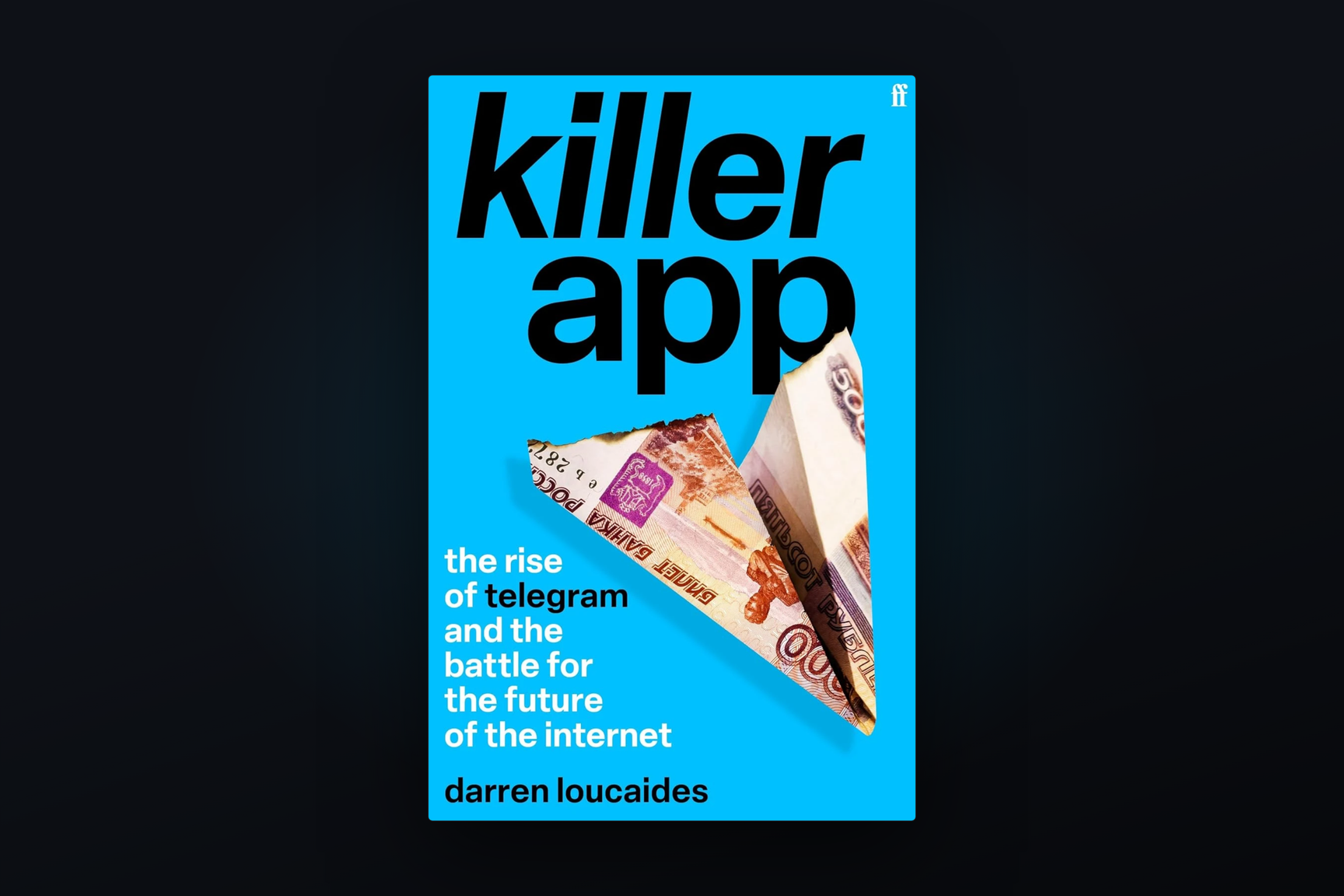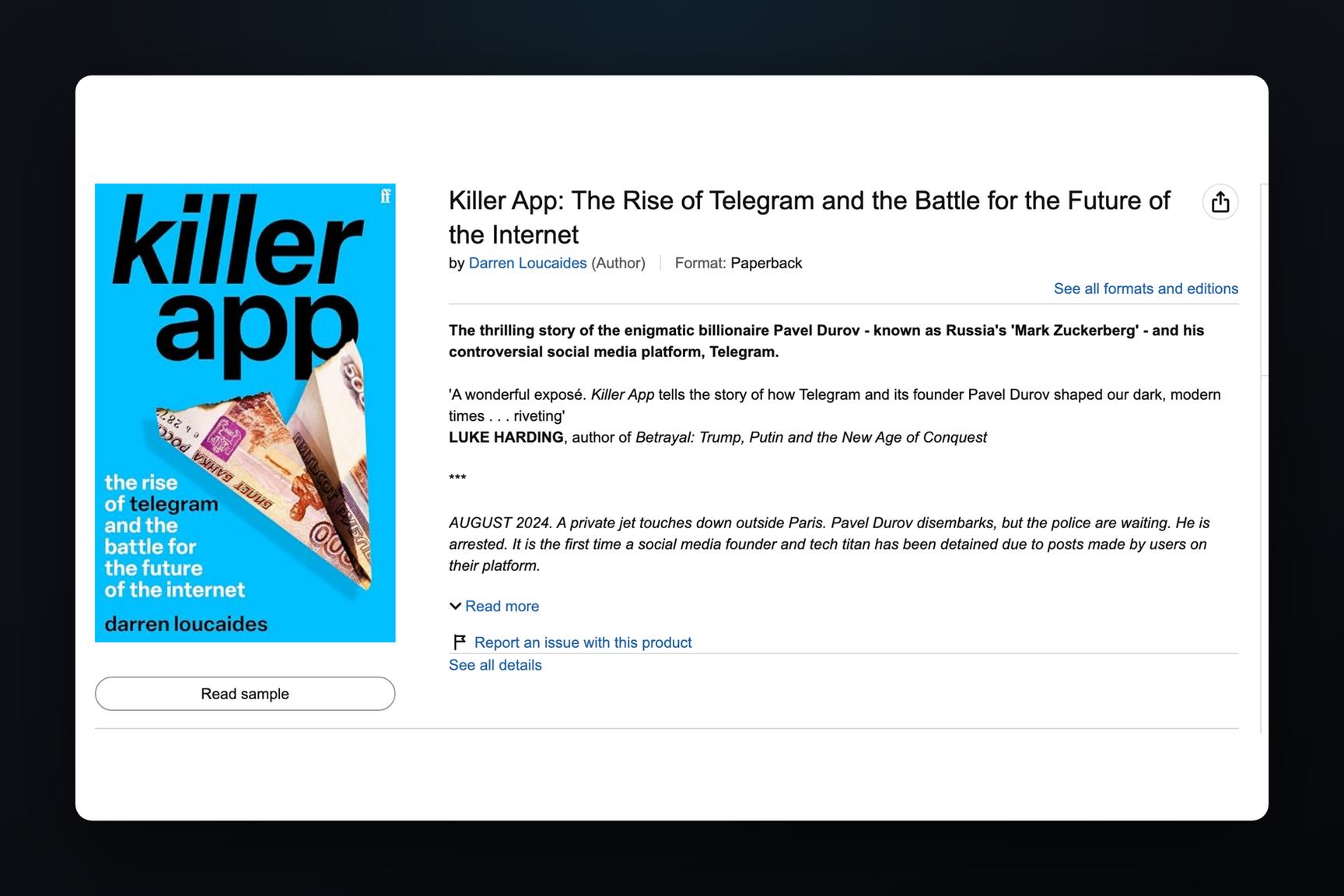
On November 5, Faber published Darren Loucaides' book "Killer App" about Telegram and Pavel Durov (read the FT review). Much of the story is familiar to Russian-speaking readers: the book retells for an English audience what the RuNet has been discussing since 2013. What's new are the people who previously remained silent or spoke differently. Telegram's former nominal owner, TON investors, the former head of growth, and the former head of government relations tell their stories under their own names.
What's Long Been Known
The conflict with UCP and Mail.ru, Durov's lawsuit against Ilya Sherbovich, Ilya Perekopsky, and Axel Neff, Anton Rozenberg's 2017 story, correspondence from the SEC case against TON — all of this was covered in Vedomosti, Forbes, Roem.ru, and Nikolay Kononov's book Durov's Code. Loucaides himself refers to these sources. SEC documents are publicly available on CourtListener, and the 2019 complaint is on the SEC website.
Below is what was not in those sources: direct quotes from the participants.
Axel Neff, Telegram's American Owner
Until spring 2014, Digital Fortress LLC and Telegram LLC were registered under Axel Neff, an engineer from the village of Colden near Buffalo. A few hours after Durov refused to give UCP 48% of Telegram, Neff handed UCP the password to the developer account in the App Store. Before the book, this story was known from Durov's lawsuit; Neff himself had not spoken publicly. He gave Loucaides a video interview around 2023, two years after their first correspondence.
Neff met Durov and Perekopsky through a childhood friend who was an exchange student at St Petersburg State University. Perekopsky once spent a summer in New York State, living in a converted chicken coop. Neff says he reminded Perekopsky of this every time he started to live lavishly.
Neff joined VKontakte in 2008, after his friend's wedding to Perekopsky's half-sister in Cherepovets. In August 2009, he bought the vk.com domain, oversaw the translation of the website into fifty languages, and sent iPod nanos to winners of an invitation contest "from the cold in New York." He earned, he says, no more than $80,000 a year and drove a Toyota pickup.
Neff recounts the birth of Telegram as follows:
- Digital Fortress was named after Dan Brown's novel of the same name, where the NSA cannot crack a cipher. He calls Durov's version about a cloud cluster for grant recipients "total BS."
- The idea was a family of applications modeled after Facebook with Instagram: Pictograph, an Instagram analogue, and a blog service called Telegraph were in development. The messenger got its working name from the latter.
- The focus was not on encryption, but on its own distributed cloud without Amazon or Google.
- The headquarters was initially listed in Buffalo, where Neff lived: from there, bills were paid, trademarks registered, and servers managed.
Durov, according to Neff, is "two different Pavel Durovs." One is a tech entrepreneur, the second is Pavel and Nikolai together, like the magicians Penn and Teller: "one does the magic, the other does the talking." He recalls that VK's investors were annoyed by the perpetually absent founder, who lived "at some presidential suite at some hotel."
Neff explains his actions by money. He was up against the Durovs with hundreds of millions, UCP and Mail.ru with hundreds of billions, and Perekopsky with millions, while he himself had "hundreds of dollars."
Ivan Tavrin on the VK Stake Deal
Ivan Tavrin, then head of Megafon, bought 12% of VK from Durov in 2014. He spoke with Loucaides from the back seat of a chauffeured car. His two statements: "Without the help of Usmanov, Durov would not own Telegram today" and "Pavel is a king of PR and marketing." According to Tavrin, pressure from the Kremlin had no influence on their deal.
Andrew Rogozov on a Visit to Facebook
In 2009, Rogozov visited Facebook with Durov. Sheryl Sandberg, he says, was "very friendly" and "She was smiling all the time," but the conversation did not go beyond pleasantries because she was "not a product person." He describes early Telegram as "a small group of enthusiasts." Loucaides interviewed him in late 2021, shortly after Rogozov left his post as VK CEO. Rogozov declined to discuss his departure.
Elies Campo, the Only English Speaker
Campo joined Telegram from WhatsApp and led growth and partnerships from Palo Alto for six years. He was not interested in salary, expecting a share. In 2017, Durov replied that no one would receive a share, but "ICO vesting" was possible for valuable employees.
His observations about the team:
- At a summer retreat in Finland in 2019, Russian was spoken at the common table. "I am the only one who speaks English with Pavel," says Campo.
- The team, he says, saw him as a person "polluted" by Silicon Valley.
- The core team addresses Durov formally ("vy") and treats him almost like a "divine figure."
A separate scene describes a conversation for which Campo invited the author to Signal instead of Telegram. When asked why, he replied: "Who knows?" Whether the company can disable client-server encryption for a specific account is, he says, "Technically, it's possible," but he doesn't know if it happens. Telegram denies employee access to correspondence.
After an article in WIRED, Telegram called Campo an "unpaid volunteer." Loucaides, in response, cites contracts with Apple, Spotify, and Stripe signed by Campo on behalf of the company.
Pavel Cherkashin on TON's Money
Cherkashin, a venture investor from San Francisco, invested in both Gram rounds. From SEC filings, it is known that after token sales, "way over" 90% of Telegram's expenses were paid with TON money. Cherkashin explains why this bothered him: money raised for one project went to another, and investors, he says, were not told that Telegram had no money for hosting and was "burning more than a $100-million-a-year hole."
Another story of his is about Facebook. Cherkashin says he heard from several people there that Zuckerberg was "furious" about TON. He calls Libra, announced in June 2019, a "copycat."
Yulia Conley, Three Years in Contact with Law Enforcement
Conley was born in Samara, moved to the US as a teenager, worked for UN Habitat for a year, and earned a master's degree at Oxford. In March 2018, an acquaintance from a conference invited her to Dubai. She waited in a hotel for two weeks, then drove to a desert resort at night and spent three days talking with Durov about climate and the future of education. There was no interview in the usual sense. At 23, she became head of government relations and moderation.
Under her leadership, Telegram joined the EU Internet Forum and began working with Europol. According to Stéphane Duguin of Europol, a joint cleanup in November 2019 was the largest removal of terrorist content in the agency's history. Conley left in late 2021 and was replaced by three young employees.
She declined to comment on Durov's arrest. She only said that after his first statements, she thought: "OK, he's got it." Conley is now developing Ethos, an emotional intelligence trainer that started as a mini app in Telegram.
Georgy Lobushkin on Russia and the "Bluff"
The former VK press secretary lives in Moscow, and Loucaides calls him close to Durov. According to Lobushkin, Russia accounted for 6–7% of the then 700 million users, and the market is "very important" to Durov. As for Durov's willingness to leave Russia rather than cooperate with the authorities, Lobushkin says "it might be a bluff."
Another quote of his concerns officials. According to Lobushkin, after VK's transition to Gazprom, officials do not use it for personal correspondence but trust Telegram: "It sounds like a joke, but it's true."
Before publication, Lobushkin asked to remove the word "bluff," writing that otherwise, his friendship with Durov would end. When the quote remained, he replied: "I will pray for you. And for me." Lobushkin called Loucaides' next article in WIRED, published after Durov's arrest, a "paid smear campaign," even though he himself was quoted in it.
The Grok Deal
In spring 2025, Durov met Elon Musk in Paris. After the meeting, he announced on X that Grok would be integrated into all Telegram applications, and Telegram would receive $300 million in cash and a stake in xAI, plus half of the revenue from subscriptions sold through the messenger. Musk replied that nothing had been signed. Durov agreed: they had "agreed in principle," with formalities still ahead. The integration never happened, and in October of the same year, Durov introduced Cocoon, an AI computing network on TON.
After the Arrest
When Durov was detained in Le Bourget, Loucaides began writing to former and current employees. "No one in Telegram was prepared for such a scenario," replied Anton Rozenberg. He saw no replacement for Durov: finance, product, and moderation policy all centered on the founder.
Creative director Andrei Iakovenko initially replied that company internal rules prohibited him from commenting on his work and asked what the question was. When the author asked how employees were coping with the arrest, Iakovenko deleted the correspondence.