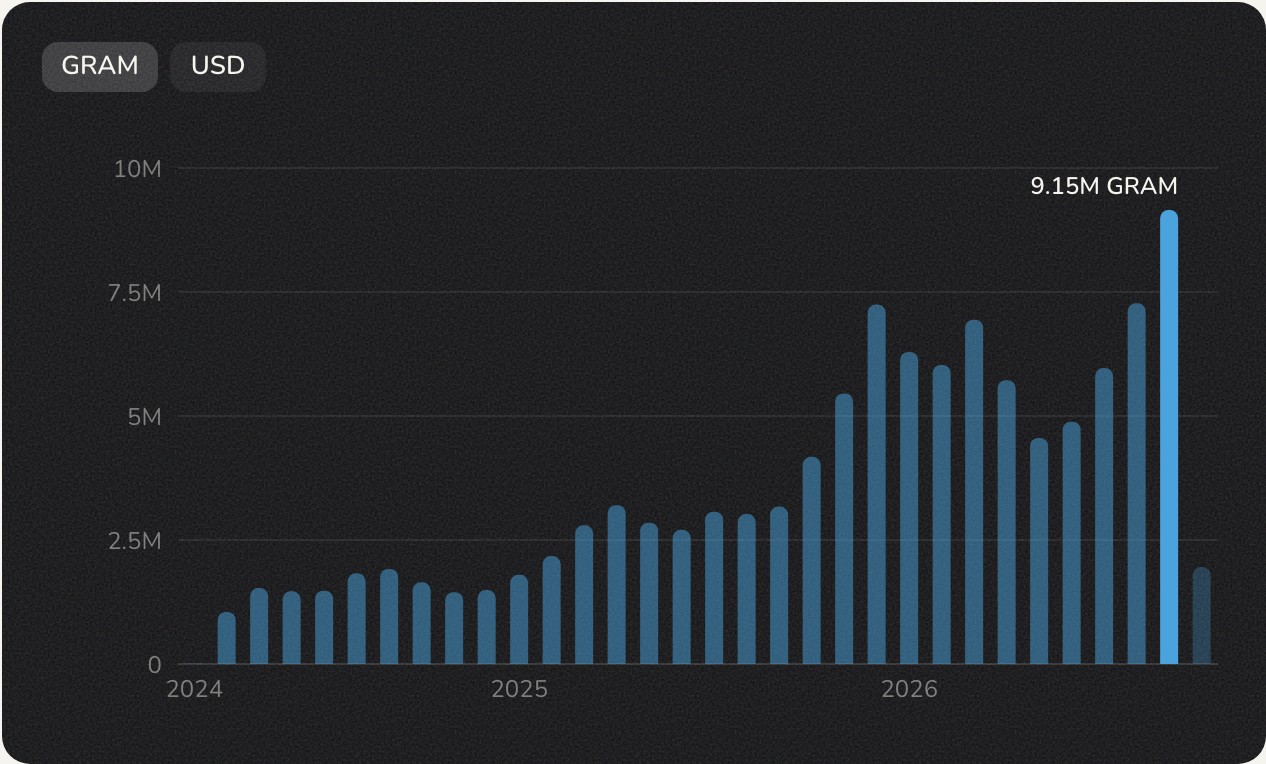
In September 2026, advertisers transferred 9.15 million GRAM to the Fragment address used to top up Telegram Ads accounts. This amount is higher than in any other month since spring 2024, when it became possible to top up Telegram Ads accounts via Fragment. In dollar terms, this is $12.9 million, also a record. In total, since March 31, 2024, 114.3 million GRAM, approximately $286 million at the exchange rate at the time of each top-up, has been spent on advertising.
How much was paid by year
| Year | GRAM | Dollars | Top-ups |
|---|---|---|---|
| 2024, since March 31 | 13.85 million | $84.0 million | 238,476 |
| 2025 | 41.67 million | $114.3 million | 582,973 |
| 2026, up to October 6 | 58.77 million | $88.2 million | 772,655 |
| Total | 114.3 million | $286.4 million | 1,594,104 |
The total GRAM amount for 2025 was surpassed by 2026 on August 6, five months before the year-end. In dollar terms, 2026 is still less than 2025.
Record Month and Record Day
September 2026 saw 9.15 million GRAM and 121,865 top-ups. A year earlier, in September 2025, there were 3.17 million GRAM and 57,373 top-ups — three times fewer coins and half as many payments. In dollar terms, the same month grew from $9.6 million to $12.9 million. Before September, the dollar record was December 2025, at $11.3 million.
September marked the fourth consecutive month of growth in GRAM. From May to September 2026, the total amount of top-ups in GRAM doubled (+101%), averaging 19% per month, while in dollars it increased by 45%, averaging 9.8% per month. The number of top-ups grew by 71%, averaging 14.4% per month.
The record day in GRAM was October 6, 2026, with 367,866 GRAM and 5,050 top-ups. Almost the same amount was received on September 21, and on October 5 and 1. The daily dollar record is older. On October 7, 2024, 120,793 GRAM were received, which at an exchange rate of $5.25 amounted to $634 thousand, while on October 6, 2026, 367,866 GRAM at an exchange rate of $1.54 amounted to $568 thousand.
The number of advertisers also increased. On October 5, 2026, 2,680 different crypto wallets topped up accounts, whereas in all of 2024, no single day saw more than 912. The average payment on October 5 was 69 GRAM.
Spring Downturn
Growth was not constant. In January–March 2026, accounts were topped up with 1.4–1.6 million GRAM per week, and March exceeded February: 6.94 million GRAM versus 6.03 million, a 15% increase. Then the amount began to decline. In April, it fell by 18%, and in May by another 20% — to 4.56 million GRAM, 34% less than in March. Weekly, this was a drop from 1.62 million GRAM in the first week of March to 1 million in May.
It was not the number of payments that fell, but their size. Weekly top-ups decreased by only 13%, and by the end of May, their number returned to March levels. The average payment during the same period decreased from 97 to 61 GRAM.
The downturn coincided with the blocking of Telegram by the Russian authorities. Restrictions came in waves starting in autumn 2025, and from the weekend of 14–15 March, the messenger practically stopped working in Russia: by March 31, its availability dropped to 30%. On April 4, Durov wrote that 65 million Russians continued to use Telegram daily via VPN. Top-ups began to decline from the first week of April, approximately three weeks after the blocking began. The connection to it is a hypothesis: blockchain payments do not reveal the advertiser's country.
Growth returned in June. September, with 9.15 million GRAM, is 32% more than March, the last month before the downturn, and 52% more than February. In dollar terms, September is 40% more than March.
Why GRAM growth is faster than dollar growth
GRAM's price fell to a quarter of what it was. The average price for 2024 was $6.11, for 2025 it was $3.08, and for 2026 it was $1.53. Therefore, the growth visible in GRAM is smoothed out in dollar terms.
But the exchange rate doesn't explain everything. By October 6, 2026, top-ups were already three times higher than in 2024, and daily top-ups increased almost fivefold: on a typical day in September 2026, there were about 4.2 thousand, compared to about 900 in autumn 2024. The number of payments and payers is growing, not just the number of coins in each payment.
Where advertisers get GRAM
Over time, 125,973 different crypto wallets have topped up advertising accounts. Almost every one (86%) received GRAM from exchange addresses, swap services, bridges, and other known services. The most frequent source is exchanges: 78% of payers received GRAM from them.
One in six advertisers — 20,089 crypto wallets — received GRAM directly from Fragment. These are payments to channel owners for ads shown in their channels, withdrawal of Telegram Stars, and settlements from Fragment auctions of usernames and gifts. These crypto wallets account for 47% of all funds spent on advertising: earnings within Telegram partially return to its own advertising.
Topping up a Telegram Ads account with GRAM involves a transfer to one Fragment address with the comment «Telegram Ad account top up». Before April 22, 2024, payments were accepted at another address. Top-ups of a user's own GRAM balance, which since July 2025 go to the same address, are not included in these figures.