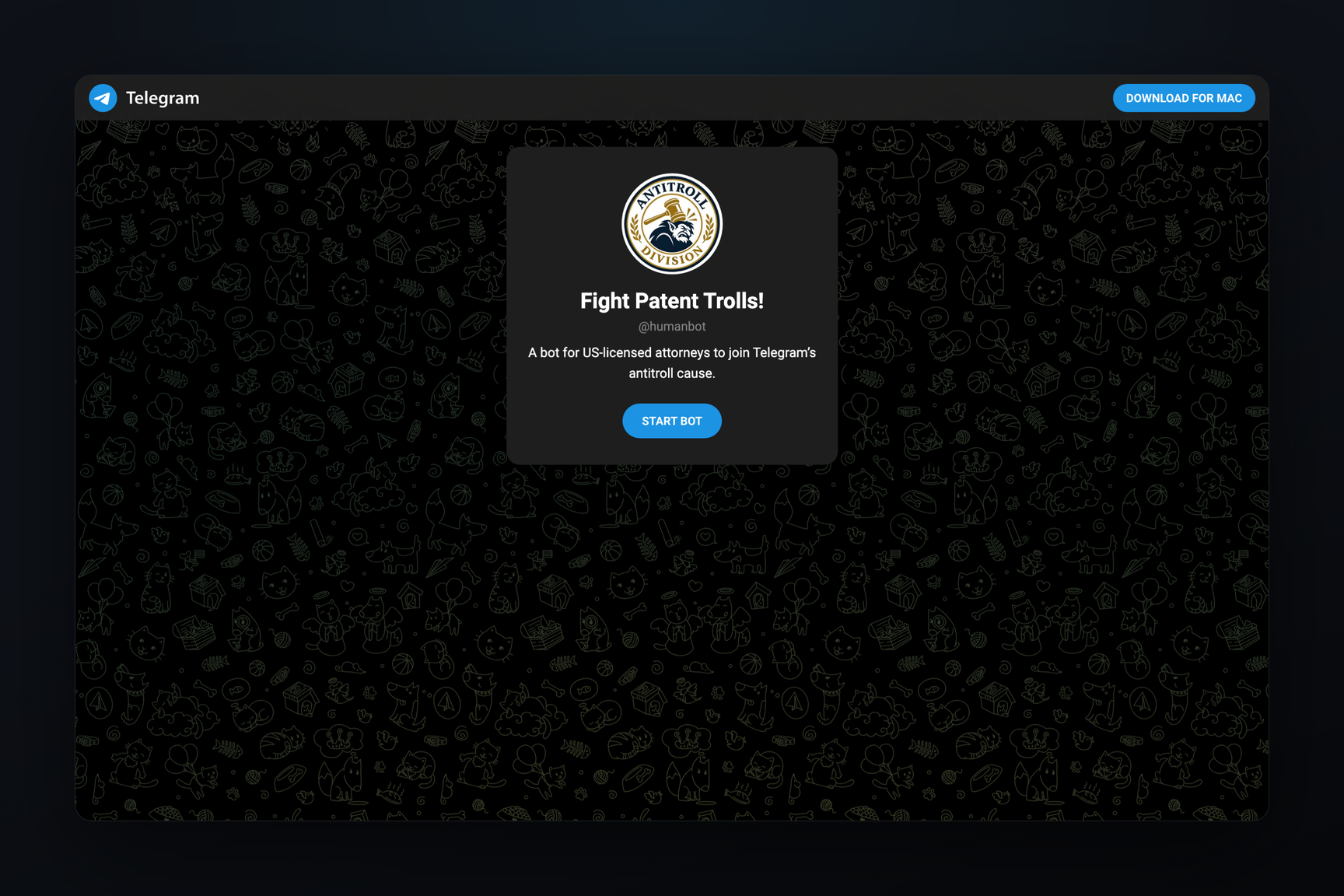
On November 16, Pavel Durov wrote that AI has made patent trolls' attacks cheaper than ever, and invited US lawyers, especially from Texas, to the bot @humanbot. The bot is called "Fight Patent Trolls!", its avatar is an Antitroll Division crest with a judge's gavel, and its description calls it an entry point for US-licensed attorneys who want to join Telegram's fight against trolls. Texas is no accident: in 2026 Telegram has been hit there with four patent suits from three plaintiffs, and the largest, over 12 patents, was filed a month ago.
Who Telegram is looking for
A patent troll is a company that makes nothing itself, but buys up patents and asserts them against those who build products. The legal term is more neutral: NPE, a non-practicing entity. Such a company earns from licence fees and settlements: according to the 2025 survey by the American Intellectual Property Law Association (AIPLA), a party's median cost of a case through trial and appeal is about $1 million when $1–10 million is at stake and about $3 million when $10–25 million is at stake, and a dispute with an NPE costs roughly 35% more than one between competitors. The defendant often finds it cheaper to pay than to go all the way to a jury.
Durov's argument is that AI has made attacking cheaper. He does not say how exactly; the most laborious part of preparing a suit is the claim chart, which maps each element of a patent claim onto a feature of someone else's product, and these are exactly the charts plaintiffs attach to their licence demand letters. Durov proposes a response that is "AI-powered and symmetrical", meaning equally cheap for the defending side. How that defence will work, the post does not say. The bot collects responses only from lawyers licensed in the US: only an attorney admitted to the court can represent a defendant in a US federal court. Everyone else is offered a game about fighting trolls in the same bot.
Why Texas
The Eastern District of Texas is the main venue for patent disputes in the US. According to the Unified Patents report for 2025, it received 27.7% of the 4,531 patent suits filed in US federal courts and 44.2% of the suits filed by NPEs. NPEs as a whole account for 55.4% of all patent cases.
Telegram ends up there because of where it is registered. Since 2017, a US company can be sued for patent infringement only where it is incorporated or has a regular and established place of business. That restriction does not apply to foreign companies, which can be sued in any district. Telegram Messenger Inc. and Telegram Group Inc. are registered in the British Virgin Islands and Telegram FZ-LLC in Dubai, so the plaintiff picks the court. All of the 2026 suits were filed in the court's Marshall division, and at least two of them are before Judge Rodney Gilstrap.
Lexington Technologies, 12 patents
On October 19, Lexington Technologies, a company from Allen, Texas, filed two suits against Telegram: 2:26-cv-00941 over seven patents and 2:26-cv-00942 over five. The defendants are all three Telegram companies.
The first suit targets the way the client connects to the server and stays connected: authentication, data sync, notification delivery and connection management. Five of the seven patents are titled "Multiple data store authentication", and the infringement description mentions auth_key_id, the key identifier that a Telegram client attaches to every encrypted message it sends to the server. The second suit covers messaging, voice calls, Live Location and content delivery.
Both suits allege willful infringement. The basis is a letter that, according to the complaints, Lexington's licensing agent sent Telegram by courier on October 1: it said the platform infringes "numerous patents" and offered access to claim charts. Willfulness matters in money terms: if the jury finds it, the court may increase damages up to three times.
The complaints themselves do not say where Lexington got the patents. According to IAM, it is a subsidiary of Dominion Harbor Enterprises, and all 12 patents come from SEVEN Networks. In September Dominion Harbor announced that with the SEVEN Networks portfolio it holds more than 22,000 patents. SEVEN Networks itself developed mobile sync technology and has litigated against Google, Apple and Samsung before.
QR Switch, QR-code login
The year's first suit, 2:26-cv-00254, was filed on March 27 by California-based QR Switch. Its patents belonged to inventor Wesley Boudville: US 8,532,632 (2013) and US 9,294,542 (2016) describe a phone that changes a barcode image on its screen. The suit targets logging in to Telegram with a QR code and linking new devices.
Telegram is not the only defendant. In 2025 the same company sued Walmart and the QuikTrip chain of gas stations, and in 2026 Toyota and Tencent. In August the Tencent case was consolidated with the Telegram case for the pretrial stage.
On August 17 Telegram asked the court to dismiss the suit, arguing that the Texas court has no jurisdiction over the company. The motion is supported by a declaration from Georgy Azarov. The parties have exchanged responses, the latest filed on November 10, and there is no ruling yet. Lexington cited the same Azarov declaration in its complaint to show that Telegram has servers in the US.
isoValent, a "method for providing social network service"
On August 28 isoValent filed suit 2:26-cv-00767 against Telegram Messenger Inc., also before Judge Gilstrap. The same day it filed a similar suit against Bending Spoons, the owner of Evernote and WeTransfer. The complaint is five pages long, and not a single document has appeared in the case since it was filed.
Which patent is asserted against Telegram cannot be seen from the public records. The register lists isoValent as the holder of US 11,188,989, "Method for providing social network service", issued in 2021.
Has this happened before
The last patent suit against Telegram in the US found before 2026 is the 2016 Uniloc case, also in the Eastern District of Texas and also before Gilstrap. It was closed in 2019. Four suits in eight months of 2026 are the first wave of this scale, and Durov's post came four weeks after its largest part.