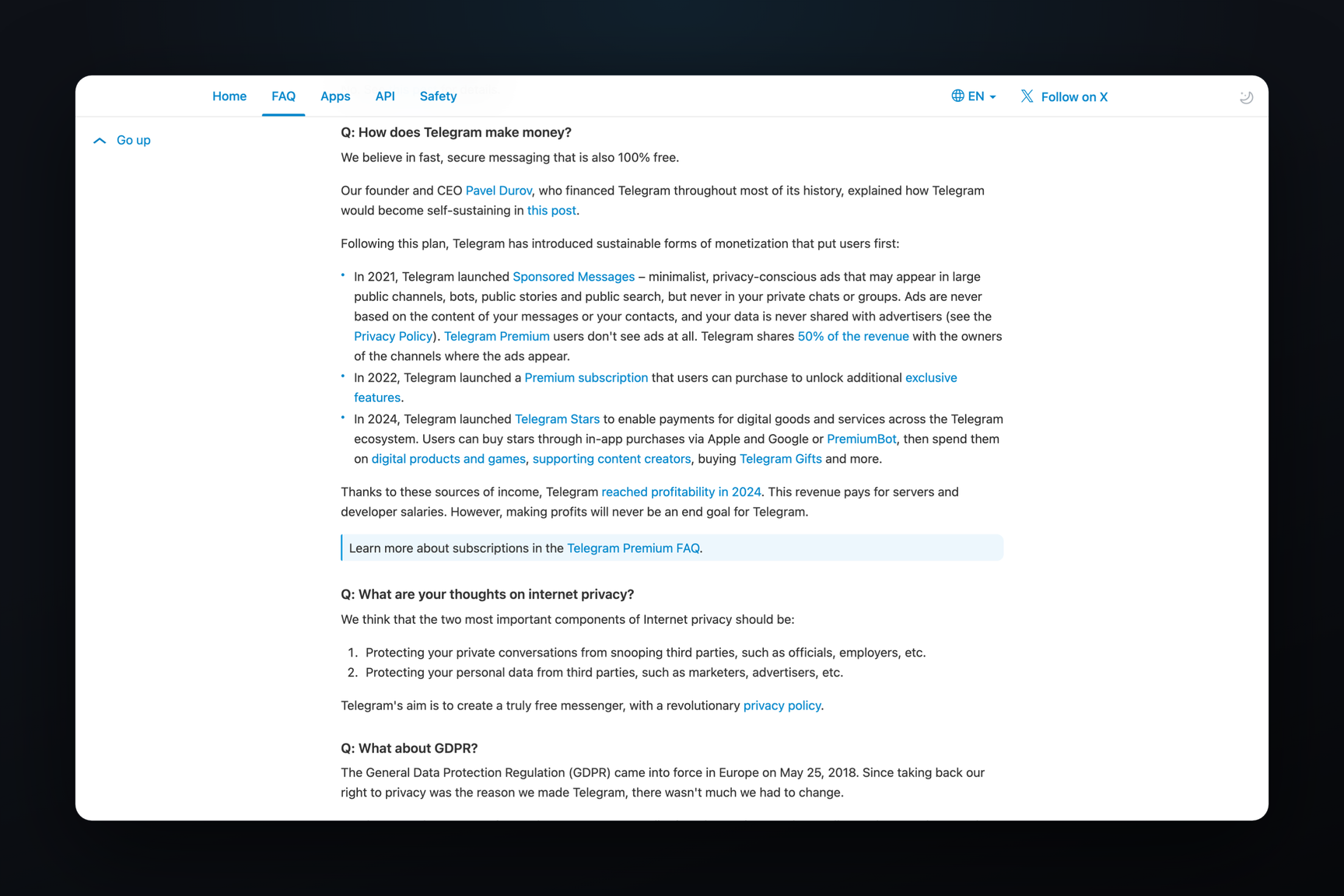
Telegram has rewritten its question-and-answer page, telegram.org/faq. The web archive snapshot from November 6 has 89 questions on it; the snapshot from November 9 has 119, and the text grew by about 40%. The answer on how Telegram makes money now says the company became profitable in 2024 and spells out where ads are shown. The line about Twitter has turned into a disclaimer of Telegram's own accounts on X and TikTok. A new section on Stars and gifts says that a collectible gift moved to the TON blockchain stays with its owner even after the Telegram account is deleted. This matters to gift owners, to owners of channels that carry ads, and to anyone who looks up answers about Telegram in its own help pages.
What changed in the answer about money
The question used to read "How are you going to make money out of this?" It now reads "How does Telegram make money?" A question about the future has become a question about the present, and the answer changed with it.
| Before November 6 | After November 9 | |
|---|---|---|
| Ads (since 2021) | may appear in certain public channels | in large public channels, bots, public stories and public search, but never in private chats or groups |
| Data used for ads | not mentioned | ads are not based on message content or contacts, and data is not shared with advertisers |
| Premium subscribers | not mentioned | see no ads at all |
| Channel owners' share | not mentioned | 50% of the ad revenue from their channel |
| Telegram Stars (since 2024) | absent | bought through Apple and Google in-app purchases or @PremiumBot and spent on digital goods, games, supporting creators and gifts |
| Bottom line | revenue covers infrastructure and developer salaries | thanks to this revenue, Telegram became profitable in 2024 |
The line "making profits will never be an end goal for Telegram" was already in the old version, almost word for word. The only new claim here is profitability. It links to a Telegram blog post and matches what Pavel Durov wrote on December 23, 2024: for the first time in three years of monetization the company was profitable, and its revenue for the year exceeded $1 billion. In March 2025 he put the 2024 profit at $547 million.
What happened to X and TikTok
The end of the FAQ used to have a "Twitter?" section with the answer "Yep. Follow us!" and a list of seven accounts: the main @telegram and six language accounts — Spanish, Italian, Korean, German, Brazilian and Arabic. The section is now called "X, Tiktok?" and holds a single line: follow Telegram on X and TikTok at your own risk, because "We have no idea who gave these people permission to post on our behalf." The language accounts are gone from the list.
The links to both accounts sit in the same line that disowns them, so the official help page sends readers to accounts it officially does not answer for.
The section about @smstelegram, the login help account, has been renamed from "login help on Twitter" to "login help on X"; its text is unchanged: the account is official, and Telegram has no other support accounts on social media.
What the FAQ says about gifts and TON
Before November 6 the FAQ had nothing on gifts apart from a mention in the answer about profile rating. They now have their own section, "Stars, Gifts and Payments", with six questions: on Stars, gifts, collectible gifts, buying and selling them, paid messages and profile rating. Five of them are new; the rating question moved over from the old version.
For a collectible gift, the FAQ lists what you can do with it: wear it as an emoji status, pin up to six on your profile, use it as a chat theme, sell it for Stars on the gift marketplace, and combine up to four gifts in crafting for a rarer version. Among these is the blockchain item: a gift can be transferred to another user or moved to the TON blockchain, and then it stays yours even if you delete your Telegram account. Gifts kept on the blockchain can still be shown on your profile if you connect your account to Fragment.
The mechanics behind that line: while a gift is inside Telegram, it is a record on Telegram's servers tied to the account, and deleting the account takes the record with it. A gift that has been moved out becomes an NFT on TON, controlled by a wallet rather than an account. The Fragment connection is apparently there so that Telegram knows which wallet belongs to the owner of the profile.
The same section gives a cheaper way to buy Stars: besides the App Store and Google Play, there are @PremiumBot and Fragment, and the FAQ says outright that this costs less and allows larger amounts. An offer to buy someone else's gift reserves the payment and refunds it if the owner declines or the offer expires. New collections are sold at auctions with several rounds, and a bid's place in the ranking sets the number of the gift.
What about the DSA question
The version of the page opened from the European Union has a question on whether Telegram is a "very large online platform" (VLOP) under the EU Digital Services Act (DSA). The answer is no. The status goes to platforms with more than 45 million average monthly recipients in the EU, and it brings annual risk assessments, external audits and direct supervision by the European Commission. According to the FAQ, as of August 2026 the parts of Telegram that count as an online platform had "significantly fewer than 45 million" over the preceding six months.
The question itself is not new. The law requires the figure to be published every six months, and in archive snapshots the answer refers to August 2025 from September 2025 onward and to February 2026 in April and May 2026. Only the date of the measurement is new.
The DSA question is not in every archive snapshot. Since July 2026, snapshots show a question about the TAKE IT DOWN Act in its place — the US law on removing intimate images published without consent; Telegram accepts requests under it through @TIDABot. In none of the snapshots checked do both questions appear together. This suggests the page is assembled differently depending on where it is opened from, but from the outside that shows only in the snapshots and is not confirmed.
What else was added
- Mini apps. The FAQ now lists what a developer receives when you open a mini app: your name, username, profile photo, language and whether you have Premium, and, like any website, your IP address. Your phone number, location and messages are shared only if you share them yourself. The name "Mini App Store" is gone from the answer: the "Apps" tab in Search simply shows popular mini apps.
- A bot that replies for you. A new question says any user can connect a bot, for example an AI assistant, to their profile in Settings > Chat Automation and choose which chats it answers in. For Telegram Business subscribers, such a bot can also manage the profile, stories and Star balance. The @agent bot, which takes your own API key from an AI service, is not mentioned in the FAQ. It has its own piece.
- New sections. "Stories", "Calls, Voice Chats and Live Streams", "Sending Media and More", "Stickers, Emoji and Reactions" have appeared, along with a section on service notifications: important notifications arrive in two verified chats, "Telegram" (number 42777) and @AbuseNotifications (4240005), and Telegram never asks for your two-step verification password or codes. The groups and channels section gained a question about Communities — a set of groups, channels and bots around one topic, whose members see the other chats and join them without an invite link.