On October 7, ICANN, the organization that decides which top-level domains will appear on the internet, published all applications for the new round. Among them was Telegram FZ-LLC's application for the .gram TLD, which Pavel Durov announced on August 18. There is a second application for the same string from the Maltese Link Freedom Group, owner of the .link TLD. Until October 21, each party can withdraw from .gram in favor of a replacement string: Telegram for .telegram, and Link Freedom Group for .jjj. If neither withdraws, .gram will be put up for auction by ICANN.

What Telegram Wrote in its Application About Names in .gram
The ICANN application is a questionnaire with hundreds of questions. Almost all answers are standard: legal entity, address, self-certifications for finances, security, and abuse. The substantive part is a single answer to question 133 regarding the TLD's mission and purpose. ICANN asks applicants to generally describe who and how the TLD will serve, and Telegram outlined a two-track scheme.

Premium Subscribers. They register a domain that by default appears as username.gram and points to their Telegram profile, just like t.me/username does now. The address can be "repoint[ed] the name elsewhere". The application does not state how much this will cost or if it will be paid at all.
Channels, Groups, and Bots. They register names through a separate process, which, as stated in the application, is "expected to follow an auction-style model", similar to the secondary market for usernames on Fragment. This is a plan, not a rule: the wording leaves Telegram flexibility.
Everyone Else. The TLD is open to anyone through accredited registrars, the same ones who sell .com domains. This is not a gesture of goodwill, but a requirement of the agreement with ICANN: a generic string TLD cannot be closed to a single owner and its affiliates (Specification 11, section 3(d)). The application states that no criteria will limit registration only to Premium subscribers, channels, or bots, and a person without a Telegram account will be able to register any available name.

All of this is an example of how the TLD could work, not contractual terms. The commitments that will be included in the operator's agreement with ICANN are proposed separately by the applicant in question 172: these are Registry Voluntary Commitments, which are incorporated into Specification 11. Telegram answered "No" to this question. Only what the agreement itself requires remains mandatory for .gram, including open registration for all.

Three more details from the same answer:
- To justify demand, Telegram cites approximately 1 billion monthly active users, about 15 million Premium subscribers, and over $4 billion in funds raised throughout its history.
- Impersonation of official Telegram channels, bots, and support is specifically mentioned: rules against this are planned to be written together with the community and the trust & safety team.
- Registry commitments are limited to "name infrastructure" and are independent of Telegram's content and data rules. These include sanctions list screening and responses to legitimate requests.


In his post, Durov promised that a website could be built on a .gram domain with a single AI query. This is not in the application: it only describes the names themselves and the addresses they point to.
Who is Applying on Behalf of Telegram
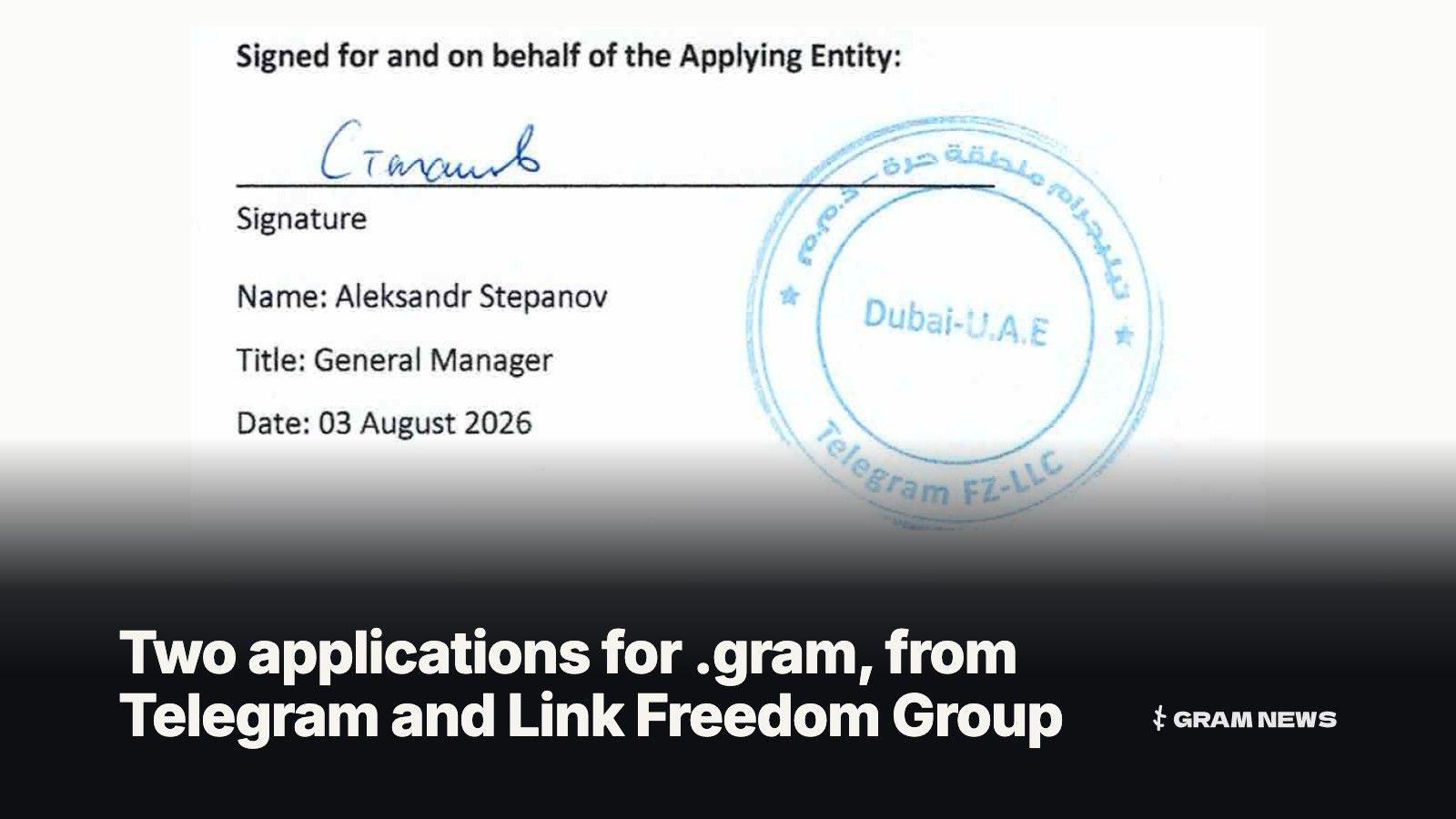
The applicant is Telegram FZ-LLC from Dubai Media City. The director is Aleksandr Stepanov, and the sole significant shareholder and ultimate controlling party is Pavel Durov. The parent companies, Telegraph Inc. and Telegram Group Inc., are registered in the British Virgin Islands.

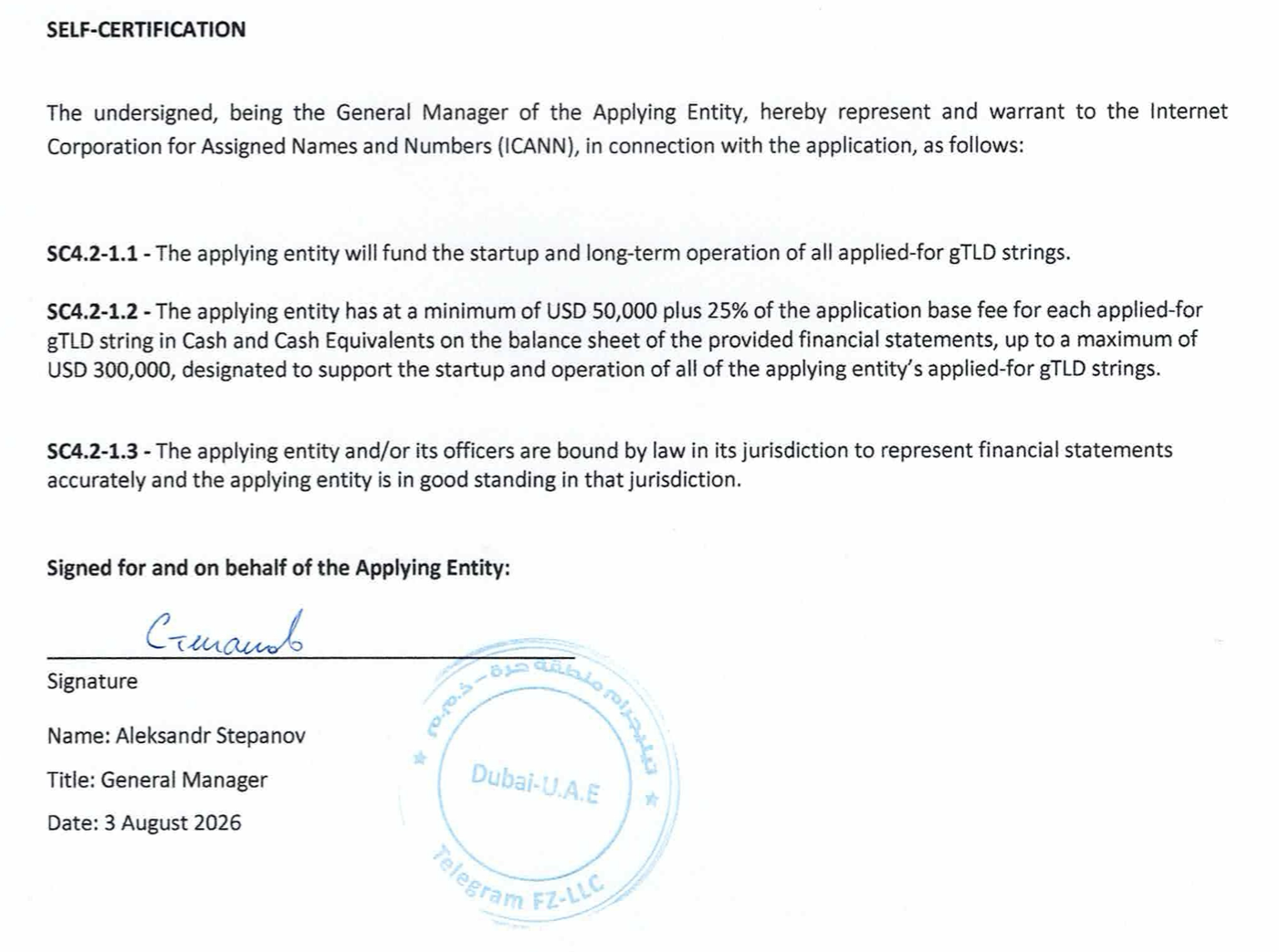
Three self-certifications for the application were signed by Stepanov as General Manager on August 3, 2026, with the company seal. The financial certification confirms that Telegram FZ-LLC will self-finance the launch and operation of the TLD and holds at least $50 thousand plus 25% of the base application fee for each string on its balance sheet. For one application, this amounts to $106,750 in cash.
Who Filed the Second Application
Link Freedom Group Ltd is registered in Birkirkara, Malta. Its sole shareholder is Vandelay Investments Ltd, and the ultimate control in the application is stated to be with Yonatan Belousov, a domain investor known in the industry as Yoni.

Its affiliate, Nova Registry, manages the .link TLD: it was acquired in 2022 from Frank Schilling's UNR when he was selling off his TLD portfolio. According to the application itself, the number of domains in .link grew from approximately 125 thousand to 300 thousand in four years.

Link Freedom Group has 316 entries in the ICANN registry, a figure the company cited after the application window closed. However, these are 158 applications and 158 corresponding replacement strings, one for each. This is more than any other legal entity in the round: XYZ.COM has 139, GoDaddy Registry has 77, and Google has 39. Identity Digital, operator of .online and hundreds of other TLDs, submitted at least 212 applications, but through 24 separate companies with names like Toddler Logic, Hair Apparent, and Oyster Dream. The ultimate owner in all cases is listed as the Ethos Capital fund. The package includes .llm, .agi, .robot, .cart, .btc, .nft, and hundreds of other words. 103 replacement strings have already been deactivated by ICANN: they coincided with strings from other applicants, and such a string cannot be taken. Thus, for example, .act, .alpha, .base, and .block were eliminated.
The answer regarding the mission for the .gram application is written as an answer about a portfolio. Link Freedom Group collects "meaningful, memorable, and commercially attractive" strings and expects that even a portion of them will give it a "diversified portfolio". There is no mention of Telegram in the application.
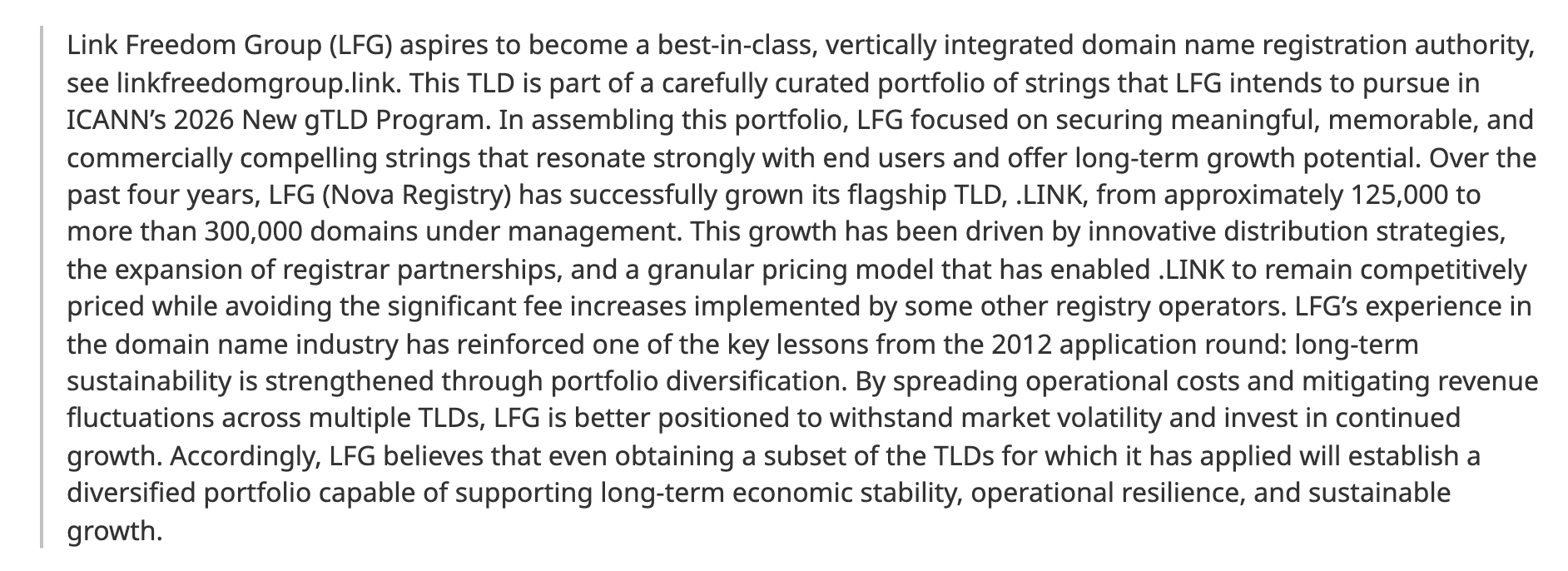
The parties explain the word itself differently: Link Freedom Group as a "unit of mass", Telegram as an abbreviation of the messenger's name.


What Unstoppable Domains Does
Every TLD has two roles. The registry operator signs the agreement with ICANN, sets prices, and decides who gets names. The registry service provider (RSP) handles the technical aspects: the database of all TLD domains, the EPP protocol through which registrars process names, DNS servers, DNSSEC, WHOIS and RDAP services, and data escrow with an independent agent. Telegram will be the operator for .gram, and Unstoppable Domains will be the provider. The provider is not named in the application itself; the company announced its role independently.
Starting with the 2026 round, providers are vetted once, separately from applications, and an applicant must choose one of the already approved providers. In February, ICANN published the first list of 28 approved providers; Unstoppable was included for the first time. The company has not had TLDs in the DNS until now: since 2018, it has been selling blockchain names like .crypto and .nft, which are recorded in smart contracts, not in the internet's root zone.
In August, Unstoppable decided not to file applications for nine of its own top-level domains, including .crypto, .wallet, .nft, .bitcoin, and .blockchain. Five partner TLDs, including .brave and .anime, were also dropped. The company offered refunds to purchasers of these names until September 25. According to the company, the reason was ICANN's draft rules, which would require blockchain names to be registered in DNS, charged for, and have owner data disclosed. CEO Matt Gould called the web3 market "small and niche." In this round, Unstoppable remained the provider for five other applications: .gram, .agi, .robot, .hub, and .xmr.
Replacement Strings: .telegram and .jjj
A replacement string is a new mechanism for the 2026 round. An applicant specifies it in advance, along with the primary string, and there is no separate fee for it. Telegram's replacement string is .telegram, and Link Freedom Group's is .jjj. ICANN has deemed both valid, as there are no other applications for them.
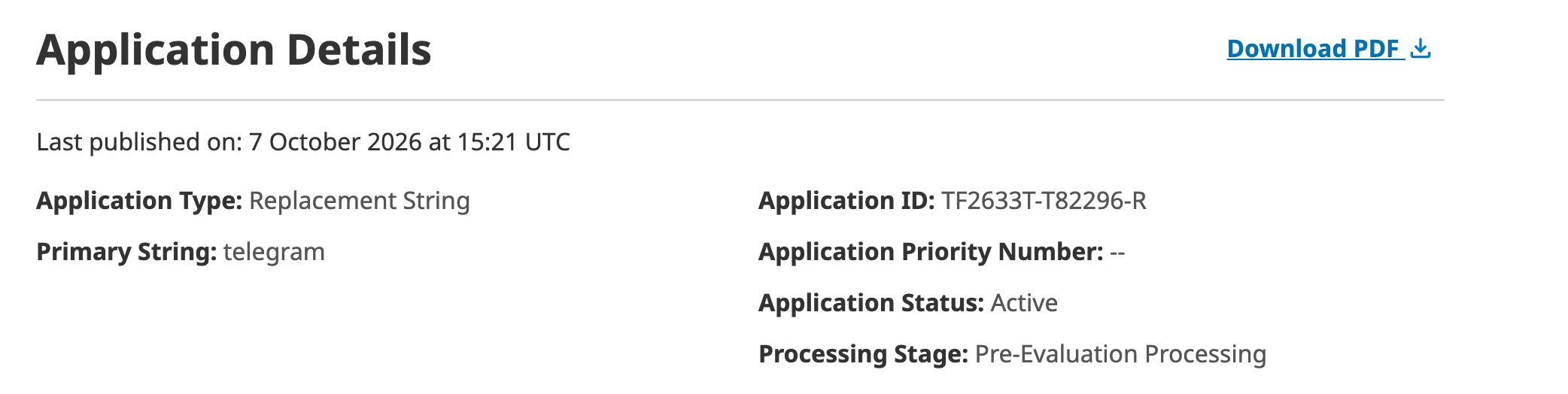
The transition works as follows:
- A switch can only occur during the replacement period, 14 days after applications are published: from October 8 to 21, 2026.
- The applicant decides independently; no competitor on the primary string is needed for this.
- If no action is taken, the replacement string is simply not used, and the application proceeds with the primary string.
- It is not possible to revert to the primary string after switching.
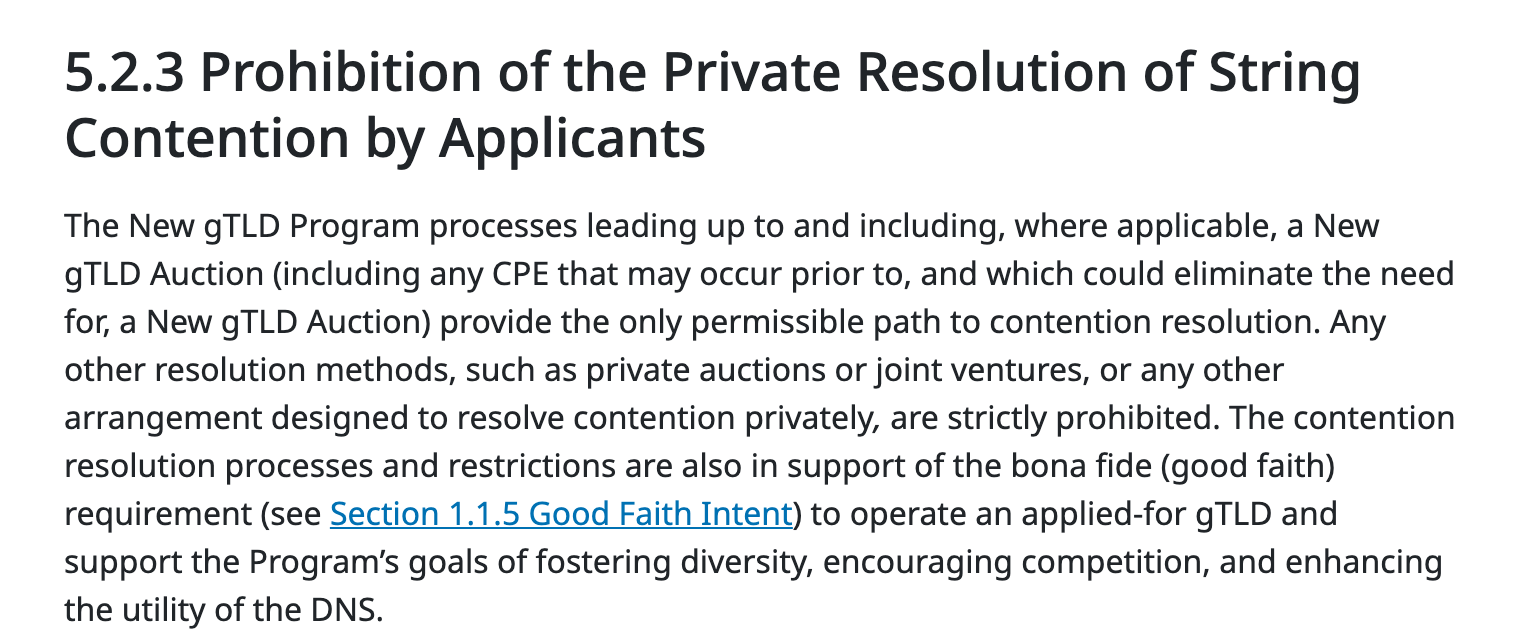
- Discussing replacement decisions with other applicants or offering any compensation for them is prohibited.
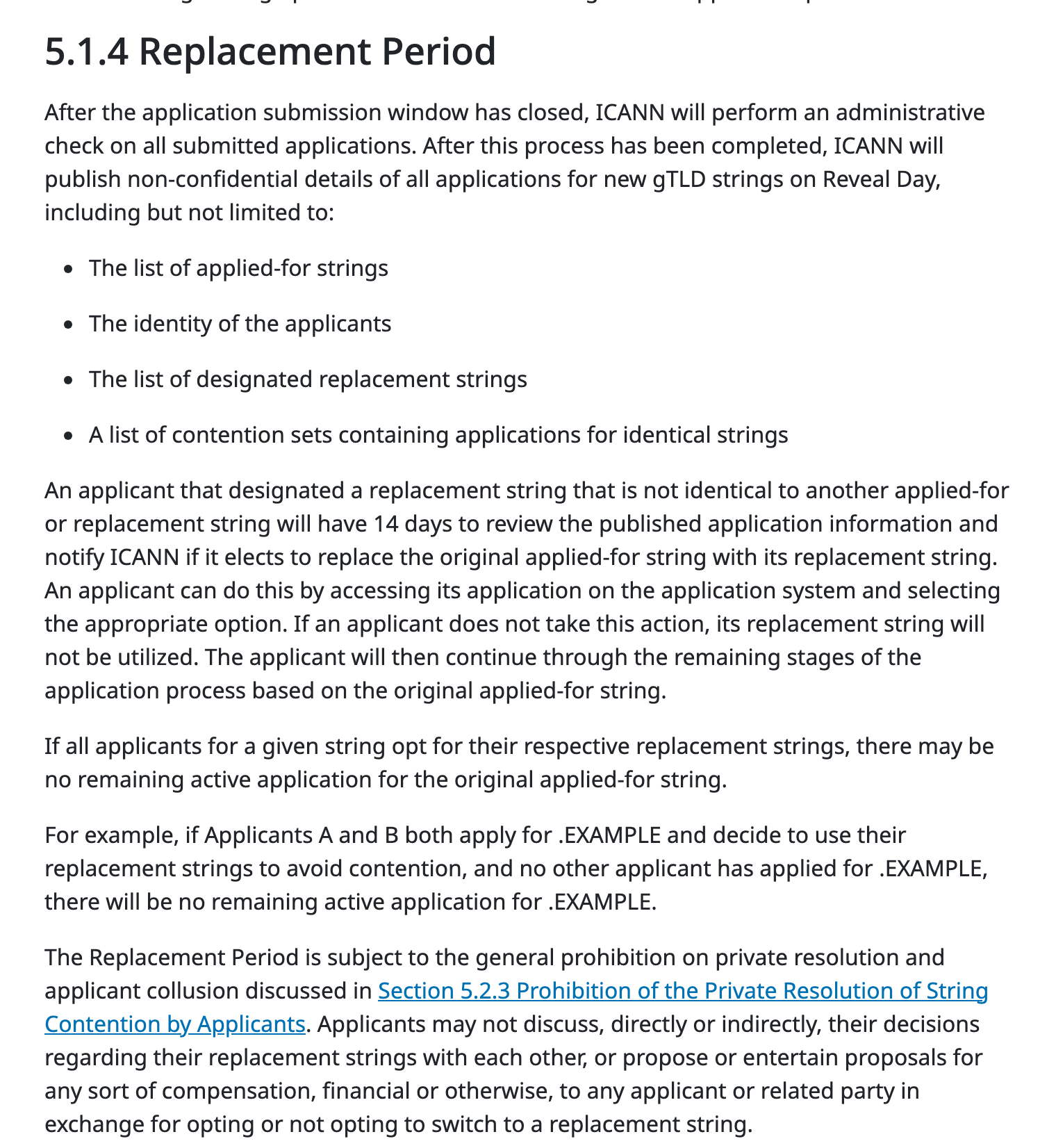
This leads to four possible outcomes, which will be known after October 21:
| Telegram | Link Freedom Group | Outcome for .gram |
|---|---|---|
| stays with .gram | stays with .gram | auction |
| stays with .gram | switches to .jjj | Telegram without an auction |
| switches to .telegram | stays with .gram | Link Freedom Group without an auction |
| switches to .telegram | switches to .jjj | no applications remain for .gram |
The rules explicitly address the last scenario: if all applicants for a string switch to replacement strings, the primary string will not remain in the round. After an auction, switching is no longer possible, as the window will have long closed.
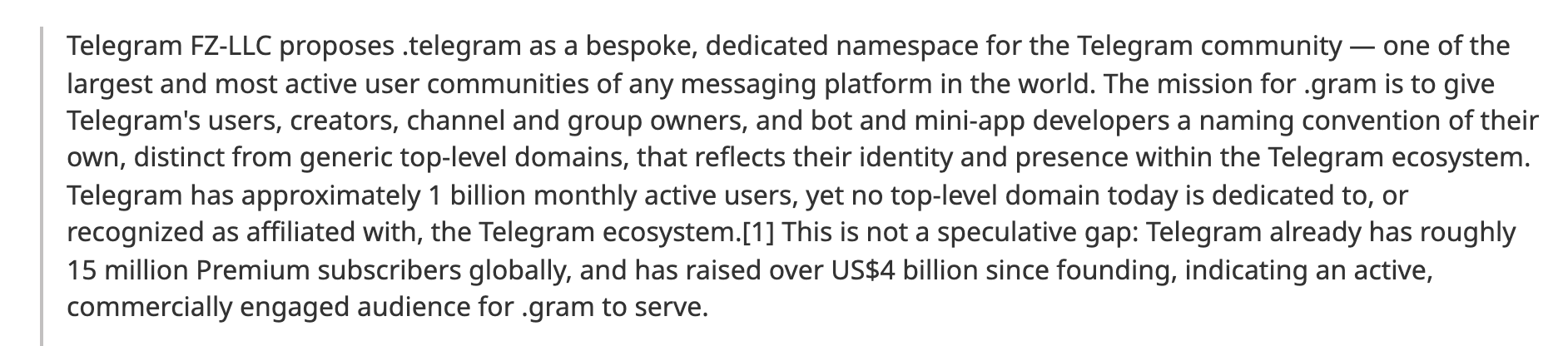
The mission statement in Telegram's replacement application is almost entirely copied from its primary application. The first sentence proposes .telegram, while the second describes the mission of .gram.
Link Freedom Group's replacement application explains its string most concisely: to the question about the meaning of .jjj, the answer is "no meaning." The transcription is provided: /ˌdʒeɪ dʒeɪ ˈdʒeɪ/.

How the Auction Will Proceed
ICANN calls it the New gTLD Auction, and there are no other ways to resolve a dispute between two regular applications in this round. Community Priority Evaluation is not involved here, as both applications were submitted as regular ones.
When
An auction is scheduled when all applications in a contention set have passed string review, objections, appeals, reconsiderations, and have no open requests for modification. Participants are notified at least 30 days in advance. ICANN will publish the final list of strings on November 17, 2026 (String Confirmation Day), after which an objection period opens. Detailed auction rules will be released no later than 60 days before the first auction. In its technical specifications for the auction provider, ICANN states that bidding will begin after all other procedures and is expected to conclude by autumn 2027. ICANN has not announced a date for the .gram auction.
How the Price Increases
The method is called ascending-clock, second-price: the price increases over time, and the winner pays the second-highest price. This was the same method used in the 2012 round.
- The price rises in rounds. Each round announces a starting and ending price, with the auctioneer choosing the increment between them.
- In each round, a participant either remains in the bidding at the ending price or withdraws, stating their last price within the round.
- Bidding ends when only one application remains in the set.
- The winner pays not its own maximum but the price at which the last rival dropped out.
Why the second price, not the first
Suppose Telegram is willing to pay up to $10 million for .gram, and Link Freedom Group up to $3 million. At $3 million, Link Freedom Group withdraws, bidding ends, and Telegram pays $3 million, not $10 million. This scheme makes an honest strategy profitable: holding out until your true value and no further. Overstating your maximum is pointless, as there will be no overpayment, and understating it is risky, as you might lose something worth buying. Therefore, the amount the winner pays is determined by how much the TLD is worth to the loser.
Is There a Ceiling?
There is no overall ceiling: bidding continues until only one remains. Each participant's personal limit is set by their deposit. The 2026 rules have not yet been published, but the 2012 rules were as follows:
| Deposit | Bidding Limit |
|---|---|
| less than $2 million | ten times the deposit |
| $2 million and more | no limits |
The first round of bidding started at one dollar. A participant could pre-set a proxy bid ("I'll hold up to this amount"), and the system would extend the bid for them. After each round, participants only saw how many applications remained in the bidding, but not whose bids or what amounts.
What Happens After Winning
- The winner transfers the remaining amount within 20 business days.
- Failure to pay incurs a 10% penalty of the price, up to $2 million, and the TLD is offered to the next participant at the price at which they withdrew.
- If the winner subsequently fails evaluation, both their bid and the applicable portion of the fee will be refunded.
- If the winner cannot sign the agreement, ICANN may, but is not obligated to, offer the TLD to the second participant.
What Is Not Allowed
From October 7, the day applications are published, participants in a contention set are prohibited from negotiating with each other. In the 2012 round, disputes were often resolved through private auctions: the loser took the winner's money and withdrew. This is now forbidden, as are joint ventures and any other private schemes. Auction proceeds go to ICANN, not to the rival. Collusion under the 2012 rules could result in forfeiture of the entire deposit, applications, and already signed agreements for other TLDs.
How Much It Costs
ICANN's base application fee is $227 thousand per application; the replacement string is included. Telegram has one application. Link Freedom Group has 158, which amounts to about $35.9 million in base fees.
Upon withdrawal of an application, ICANN refunds a portion of the fee, with the amount decreasing the later it is withdrawn:
| When Withdrawn | Refund | In Dollars |
|---|---|---|
| up to 10 days after November 17, 2026 | 65% | $147 550 |
| before applicant evaluation begins | 35% | $79 450 |
| before agreement signing | 20% | $45 400 |
How much Telegram pays Unstoppable Domains as a provider is not disclosed.
For scale, here are auctions from the previous round. In February 2015, Google won .app against twelve competitors, including Amazon and Donuts: bidding lasted two days and concluded at $25 001 000. The record is .web: in July 2016, it was acquired by the little-known Nu Dot Co for $135 million, and soon after, Verisign, the operator of .com, acknowledged that it had financed the bid.
What's Ahead
| Date | Event |
|---|---|
| October 7, 2026 | ICANN publishes all applications for the round |
| October 8–21 | window for parties to switch to .telegram and .jjj |
| November 17 | final list of strings and contention sets |
| November 27 | last day for withdrawal with a 65% refund |
| after November 17 | objections, evaluation of applicants and strings |
| by autumn 2027, as expected by ICANN | auction, if two applications remain for .gram |