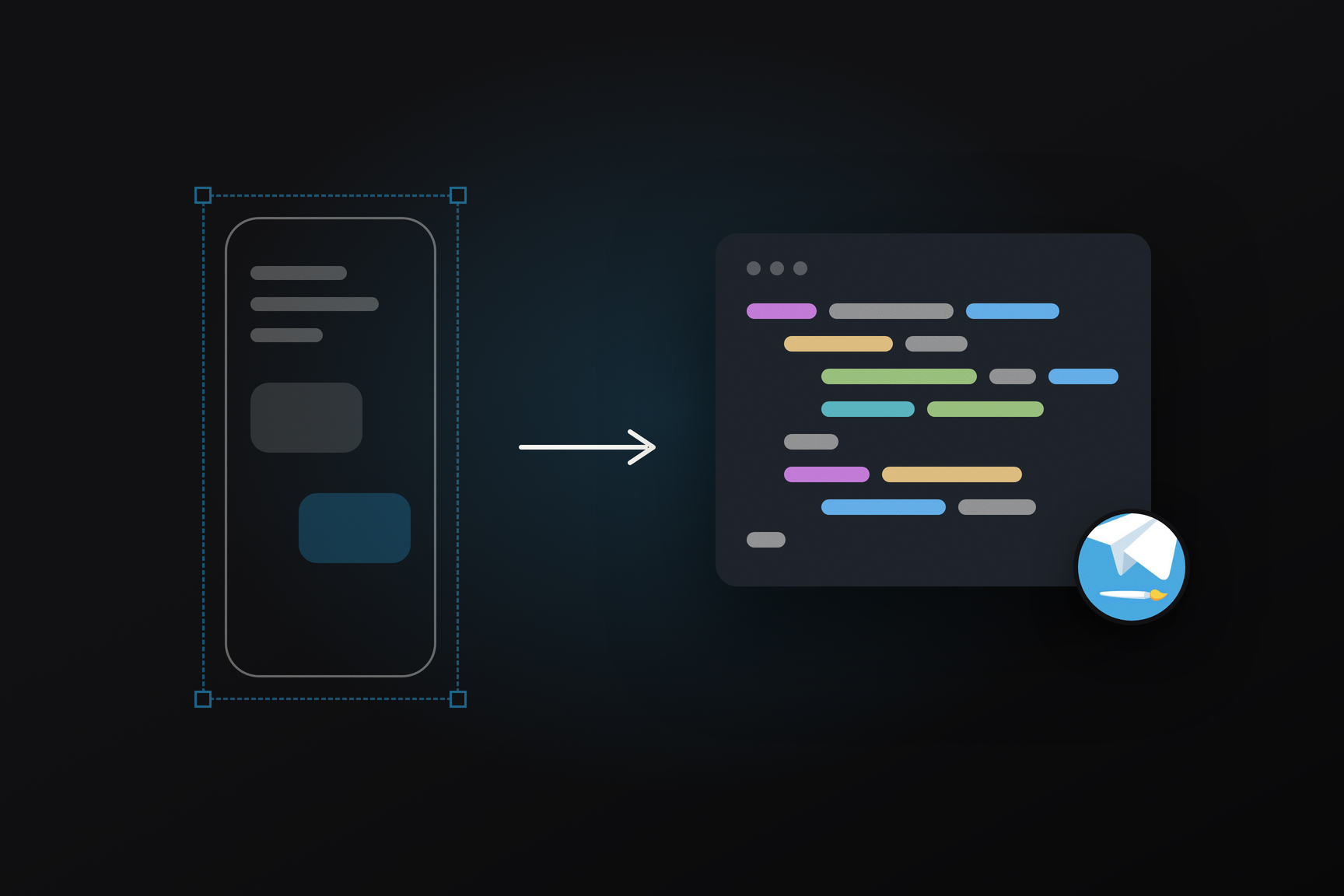
On October 11, the Telegram Designers channel changed its rules for accepting concepts: now, only working code ready for implementation is accepted, along with a video demonstrating the feature in action. Static mockups, demo videos without underlying code, and text descriptions of ideas are no longer accepted. This applies to everyone submitting interface ideas to Telegram via this channel, including those who have never coded: the post explicitly suggests using AI tools for this.
What Exactly Is Required Now
The post lists two mandatory elements:
- working code, ready for implementation;
- a video demonstrating the feature in action.
Three formats that previously formed the core of the channel are now prohibited: static mockups, videos without code, and text concepts. Video remains, but its role changes — from being the concept itself, it becomes a screen recording of something already functional. The post includes an example from an iOS team designer, noting that it's a ready-to-use implementation, not a motion video.
Submissions are to be sent to the channel's direct messages — the 'Message' button on the @designers page. There is no separate form, bot, or contest page.
What the post doesn't specify:
- the platform — Android, iOS, Desktop, or any;
- the code format — a modification to an official client or a separate prototype;
- the submission method — a link to a repository, an archive, or a patch;
- remuneration — the post says nothing about it.
The phrase "ready for implementation" strongly suggests code in terms of the client itself: the same language, the same components that can be integrated into the application without rewriting. This is an interpretation, not a rule from the post.
Pavel Durov himself did not formulate the new rules: he forwarded the @designers post to his channel two and a half hours after its publication. In retellings, this is presented as his statement, but the text belongs to the designers' channel.
How to Propose a Concept Under the New Rules
1. Choose a client and build it. The source code for all three main clients is open and updated with releases:
| Client | Repository | Language | License | Build Tools |
|---|---|---|---|---|
| Android | DrKLO/Telegram | Java | GPL-2.0 | Android Studio, Android NDK |
| Desktop | telegramdesktop/tdesktop | C++ (Qt) | GPL-3.0 | instructions for Windows, macOS, and Linux |
| iOS | TelegramMessenger/Telegram-iOS | Swift | no license file in root, README requires publishing your code | Xcode and Bazel via Make.py script |
The entry barrier varies. Android opens in Android Studio as a regular project. Desktop requires first building third-party libraries following separate instructions for each system — on Windows, this means Visual Studio and Python. iOS is built by the Bazel system, and to generate the project, the README requests a team identifier from an Apple developer certificate.
2. Obtain your api_id. The READMEs of all three repositories require any build to connect to Telegram servers using its own application key, which is issued on my.telegram.org. The same page lists other conditions: do not name the build Telegram, do not use the branded logo, and publish your code if the build is distributed — these are license requirements.
3. Create the feature. There are two paths. The first is to make changes directly in a client fork: the feature lives in a real application, with real data and animations. The second is a separate small application that uses the same components as the client. The iOS team itself uses the second path: the repository contains a context menu prototype — a standalone application that compiles the same animation file as Telegram and runs in a simulator without a signature.
4. Connect an AI assistant. The post considers this normal: "lack of programming experience" is compensated, it says, by curiosity, attention to detail, and a good prompt. The assistant needs to be given the built project and a description of the feature; the iOS repository already contains instructions for it — how to build, how to run tests, how to update the application in the simulator without losing login.
5. Record the screen. The video is shot from a working build — from a phone, simulator, or Desktop window. The difference from previous motion videos is verifiable: everything on the screen must be reproducible when the code is run.
6. Submit. Send the video and code to direct messages @designers. The code format is not specified; a public fork on GitHub with a link to the commit covers both the license requirement and ease of verification.
How Concepts Were Accepted Before
The channel has existed since December 2018, with its description stating that it's for feature suggestions for Telegram from designers worldwide, to be sent directly to @designers. For years, the format was a post with an image or animation and the caption "Suggested by @author," sometimes with a quote from the author about what the feature does. Recognition was limited to publication with a mention; money was not discussed in these posts.
The connection between a concept and a feature in the app was not announced in the channel. However, there have been coincidences: a concept for sending multiple chats at once via a shared folder appeared in the channel on April 2, 2022, and shareable folders were introduced in Telegram on April 21, 2023.
The second avenue is contests, which the channel announces together with @contest, and submissions are published on contest.com:
| Year | Contest | Prize Pool | Submissions |
|---|---|---|---|
| 2021 | Calls for Telegram X on Android | from $30,000 | 47 |
| 2022 | Second Round, Windows 11 Client | $40,000 | — |
| 2023 | Android App Redesign | $30,000 | 89 |
| 2023 | App Icon | $10,000 | 252 |
| 2024 | Design Competition | up to $30,000 | 185 |
| 2024 | Second Round | up to $30,000 | 135 |
| 2025 | Design Contest, "Nodes" | $50,000, raised to $75,500 | 192 |
| 2026 | Express Round for Prize Winners | up to $1,000 per feature | — |
Contests promised more than just money: winners in 2024 and 2025 were offered the opportunity to join the Telegram design team. Following the 2025 contest, no first place was awarded — no single submission clearly surpassed the others — and the prize pool was increased by more than half. In September, payouts for the Design Contest and the Digital Freedom contest together totaled $222,000.
All these contests accepted exactly what the channel no longer takes. The rules for 2025 required static mockups for Android and iOS in both themes, a motion video as the final submission, and optionally, a Figma link. The 2026 express round explicitly allowed static mockups if the feature didn't change animations. Code was never required in design contests — Telegram has separate developer contests for that on the same platform.
The post does not state whether the new rule applies to future Design Contests: it concerns concept submissions via direct messages.
Where the Rule Came From
The post explains it with one phrase: the gap between "what if..." and "look, it works" has never been so small, and this has changed how Telegram develops features. The mechanics are clear from the team's perspective. A mockup is a task for a developer: it needs to be translated into code, and some decisions not visible in the image (transitions, loading states, behavior on a small screen) are made by the developer. Working code already contains these decisions, and it can be read, run, and integrated.
Within the team, the shift to AI tools is evident in the iOS repository itself. The file with instructions for AI assistants has been in it since April 2025, and over a year and a half, it has been modified by 135 commits — it describes for the agent the build process, tests, and known project pitfalls. Nearby are an exclusion file for Cursor, server settings through which the assistant manages the build in Xcode, and a prototypes folder where a separate application tests menu animations using the same source files as the client.
On October 7, Durov, in a response to a question about what inspires him most about Telegram's future, named the value the team can provide to people with the latest AI tools, enabling them to do "100 times more than before." Everything built so far, according to him, pales in comparison to what can be built in the next year. The response was forwarded to a channel by an interlocutor; there is no separate post from @durov with these words.